

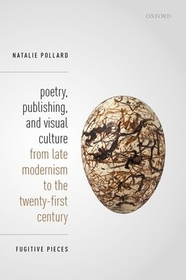
Poetry, Publishing, and Visual Culture from Late Modernism to the Twenty-first Century
Fugitive Pieces
-
20% KEDVEZMÉNY?
- A kedvezmény csak az 'Értesítés a kedvenc témákról' hírlevelünk címzettjeinek rendeléseire érvényes.
- Kiadói listaár GBP 100.00
-
45 150 Ft (43 000 Ft + 5% áfa)
Az ár azért becsült, mert a rendelés pillanatában nem lehet pontosan tudni, hogy a beérkezéskor milyen lesz a forint árfolyama az adott termék eredeti devizájához képest. Ha a forint romlana, kissé többet, ha javulna, kissé kevesebbet kell majd fizetnie.
- Kedvezmény(ek) 20% (cc. 9 030 Ft off)
- Kedvezményes ár 36 120 Ft (34 400 Ft + 5% áfa)
- A kedvezmény érvényes eddig: 2026. június 30.
Iratkozzon fel most és részesüljön kedvezőbb árainkból!
Feliratkozom
45 150 Ft

Beszerezhetőség
Becsült beszerzési idő: A Prosperónál jelenleg nincsen raktáron, de a kiadónál igen. Beszerzés kb. 3-5 hét..
A Prosperónál jelenleg nincsen raktáron.
Why don't you give exact delivery time?
A beszerzés időigényét az eddigi tapasztalatokra alapozva adjuk meg. Azért becsült, mert a terméket külföldről hozzuk be, így a kiadó kiszolgálásának pillanatnyi gyorsaságától is függ. A megadottnál gyorsabb és lassabb szállítás is elképzelhető, de mindent megteszünk, hogy Ön a lehető leghamarabb jusson hozzá a termékhez.
A termék adatai:
- Kiadó OUP Oxford
- Megjelenés dátuma 2020. május 28.
- ISBN 9780198852605
- Kötéstípus Keménykötés
- Terjedelem332 oldal
- Méret 239x164x22 mm
- Súly 664 g
- Nyelv angol
- Illusztrációk 18 Illustrations 0
Kategóriák
Rövid leírás:
Exploring works by Djuna Barnes, David Jones, F.T. Prince, Denise Riley, Paul Muldoon, and Ted Hughes, this volume traces the relationship between twentieth-century poetry and art to question the role of art in society.
TöbbHosszú leírás:
This is a book about contemporary literary and artistic entanglements: word and image, media and materiality, inscription and illustration. It proposes a vulnerable, fugitive mode of reading poetry, which defies disciplinary categorisations, embracing the open-endedness and provisionality of forms. This manifests itself interactively in the six case studies, which have been chosen for their distinctness and diversity across the long twentieth century: the book begins with the early twentieth-century work of writer and artist Djuna Barnes, exploring her re-animation of sculptural and dramatic sources. It then turns to the late modernist artist and poet David Jones considering his use of the graphic and plastic arts in The Anathemata, and next, to the underappreciated mid-century poet F.T. Prince, whose work uncannily re-activates Michelangelo's poetry and sculpture. The second half of the book explores the collaborations of the canonical poet Ted Hughes with the publisher and artist Leonard Baskin during the 1970s; the innovative late twentieth-century poetry of Denise Riley who uses page space and embodied sound as a form of address; and, finally, the contemporary poet Paul Muldoon who has collaborated with photographers and artists, as well as ventriloquising nonhuman phenomena.
The resulting unique study offers contemporary writers and readers a new understanding of literary, artistic, and nonhuman practices and shows the cultural importance of engaging with their messy co-dependencies. The book challenges critical methodologies that make a sharp division between the textual work and the extra-literary, and raises urgent questions about the status and autonomy of art and its social role.
This is a sophisticated corrective to the New Criticism approach ... Though the book bristles with the buzzwords of contemporary critical theory, when the focus is on specific poetic texts a simple clarity comes forth ... For specialists in critical theory.
Tartalomjegyzék:
Introduction
PART ONE
Lunatic Forms: Djuna Barnes' Stone Guests
Built Words: David Jones, Art and Architecture
Moving Statues: F.T. Prince, Legacy and Michelangelo
PART TWO
Collaboration: Canonical Hybridity, Ted Hughes, and Leonard Baskin
Reverberation: Denise Riley, Ethics and Embodiment
Ventriloquism: Paul Muldoon's Feast of Forms
Afterword

