

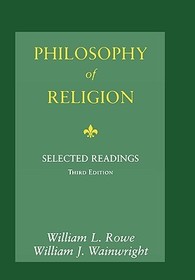
Philosophy of Religion
Selected Readings
-
10% KEDVEZMÉNY?
- A kedvezmény csak az 'Értesítés a kedvenc témákról' hírlevelünk címzettjeinek rendeléseire érvényes.
- Kiadói listaár GBP 127.99
-
57 787 Ft (55 035 Ft + 5% áfa)
Az ár azért becsült, mert a rendelés pillanatában nem lehet pontosan tudni, hogy a beérkezéskor milyen lesz a forint árfolyama az adott termék eredeti devizájához képest. Ha a forint romlana, kissé többet, ha javulna, kissé kevesebbet kell majd fizetnie.
- Kedvezmény(ek) 10% (kb. 5 779 Ft)
- Kedvezményes ár 52 008 Ft (49 532 Ft + 5% áfa)
Iratkozzon fel most és részesüljön kedvezőbb árainkból!
Feliratkozom
57 787 Ft

Beszerezhetőség
Megrendelésre a kiadó utánnyomja a könyvet. Rendelhető, de a szokásosnál kicsit lassabban érkezik meg.
Why don't you give exact delivery time?
A beszerzés időigényét az eddigi tapasztalatokra alapozva adjuk meg. Azért becsült, mert a terméket külföldről hozzuk be, így a kiadó kiszolgálásának pillanatnyi gyorsaságától is függ. A megadottnál gyorsabb és lassabb szállítás is elképzelhető, de mindent megteszünk, hogy Ön a lehető leghamarabb jusson hozzá a termékhez.
A termék adatai:
- Kiadás sorszáma 3
- Kiadó OUP USA
- Megjelenés dátuma 1998. július 2.
- ISBN 9780195155112
- Kötéstípus Puhakötés
- Terjedelem558 oldal
- Méret 244x170x33 mm
- Súly 907 g
- Nyelv angol 0
Kategóriák
Rövid leírás:
An accessible introduction to the topic with essays covering religious pluralism, teleological and moral arguments for God's existence, and the problem of evil.
TöbbHosszú leírás:
This third edition of Philosophy of Religion offers a wide variety of readings designed to introduce students to important issues in the philosophy of religion. The authors have coupled new readings--including essays by Robert M. Adams, Peter Van Inwagen, and William P. Alston--with readings from classical philosophers, thus offering instructors and students an even more comprehensive and well-focused textbook. Many of the essays are particularly accessible to beginning philosophy students. New essays cover religious pluralism, teleological and moral arguments for God's existence, and the problem of evil. Philosophy of Religion, 3/e is an excellent choice for use as a main text or as a supplement for introductory courses in philosophy and religion.
TöbbTartalomjegyzék:
I. The Nature and Attributes of God
Introduction
The Divine Nature Exists through Itself, from Monologium
God's Nature Cannot Be Separated from His Existence, from Summa Theologica
Divine Necessity
Can God's Existence Be Disproved?
Divine Foreknowledge and Freedom of the Will, from The Consolation of Philosophy
The Knowledge of God, from Summa Theologica
Divine Omniscience and Voluntary Action
The Omnipotence of God, from Summa Theologica
Can God Do Evil?, from A Discourse Concerning the Being and Attributes of God
Omnipotence
God Is Timeless, Immutable, and Impassible, from Proslogium and Monologium
The Simplicity and Immutability of God, from Summa Theologica
The Divine Relativity, from The Divine Relativity
II. Arguments for the Existence of God
Introduction
The Ontological Argument, from Proslogium
The Perfect Island Objection
Reply to Gaunilo
The Supremely Perfect Being Must Exist, from Meditations on First Philosophy
Of the Impollibility of an Ontological Proof, from The Critique of Pure Reason
A Modal Version of the Ontological Argument, from God, Freedom and Evil
The Existence of God and the Beginning of the World, from Summa Theologica
Infinite Causal Regression
The Cosmological Argument, from Discourse Concerning the Being and Attributes of God
Some Objections to the Cosmological Argument, from Dialogues Concerning Natural Religion
Two Criticisms of the Cosmological Argument
The Evidence of Design, from Natural Theology
Design and the Teleological Argument, from Dialogues Concerning Natural Religion
The Wider Teleological Argument, from Metaphysics
The Moral Argument, from Kant's Critique of Practical Reason and Other Works
Kant on the Moral Argument, from The Miracle of Theism
Religion and the Queerness of Mortality
III. The Problem of Evil
Introduction
The Argument Reduced to Syllogistic Form, from Theodicy
God and the Problem of Evil, from Dialogs Concerning Natural Religion
Rebellion, from The Brothers Karamazov
The Problem of Evil and Some Varieties of Atheism
The "Soul-Making" Theodicy, from Evil and the God of Love
The Free Will Defense, from God, Freedom, and Evil
IV. Objections to Traditional Theism
Introduction
Religious Belief, from Lectures and Conversations
Philosophy, Theology and the Reality of God
A Critique of Wittgensteinian Fideism, from The Autonomy of Religious Belief
The Pluralistic Hypotheses, from An Interpretation of Religion
A Religious Theory of Religion
Worldviews, Criteria and Epistemic Circularity
V. Mysticism and Religious Experience
Introduction
The Nature of Mysticism, from The Teachings of the Mystics
Nature Mysticism, Soul Mysticism and Theistic Mysticism, from Mysticism: Sacred and Profane
Numinous Experience and Mystical Experience, from A Dialog of Religion
The Appeal to Religious Experience, from Religion, Philosophy and Psychical Research
The Cognitive Status of Mystical Experience, from Mysticism: A Study of its Nature, Cognitive Value, and Moral Implications
Is Religious Belief Rational?"
VI. Faith and Miracles
Introduction
Reason and Revelation, from On the Truth of the Catholic Faith
The Wager, from Pensees
The Logic of Pascal's Wager
The Ethics of Belief, from Lectures and Essays
The Will to Believe, from The Will to Believe and Other Essays in Popular Philosophy
Is Belief in God Properly Basic?
Toward a Sensible Evidentialism: On the Notion of "Needing Evidence"
Of Miracles, from An Enquiry Concerning Human Understanding
Miracles
Revelation and Miracle, from Systematic Theology
VII. Death and Immortality
Introduction
The Soul
The Problem of Life After Death
A Future State, from A Discourse Concerning the Unalterable Obligations of Natural Religion, and the Truth and Certainty of the Christian Revelation
Doubts About Immortality, from Two Essays on Suicide and Immortality
The Dependency Argument, from Some Dogmas of Religion

