

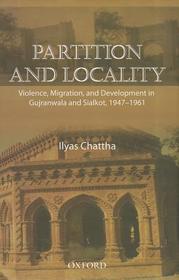
Partition and Locality
Violence, Migration, and Development in Gujranwala and Sialkot 1947-1961
-
10% KEDVEZMÉNY?
- A kedvezmény csak az 'Értesítés a kedvenc témákról' hírlevelünk címzettjeinek rendeléseire érvényes.
- Kiadói listaár GBP 16.99
-
8 116 Ft (7 730 Ft + 5% áfa)
Az ár azért becsült, mert a rendelés pillanatában nem lehet pontosan tudni, hogy a beérkezéskor milyen lesz a forint árfolyama az adott termék eredeti devizájához képest. Ha a forint romlana, kissé többet, ha javulna, kissé kevesebbet kell majd fizetnie.
- Kedvezmény(ek) 10% (cc. 812 Ft off)
- Kedvezményes ár 7 305 Ft (6 957 Ft + 5% áfa)
Iratkozzon fel most és részesüljön kedvezőbb árainkból!
Feliratkozom
8 116 Ft

Beszerezhetőség
A kiadónál véglegesen elfogyott, nem rendelhető. Érdemes újra keresni a címmel, hátha van újabb kiadás.
Why don't you give exact delivery time?
A beszerzés időigényét az eddigi tapasztalatokra alapozva adjuk meg. Azért becsült, mert a terméket külföldről hozzuk be, így a kiadó kiszolgálásának pillanatnyi gyorsaságától is függ. A megadottnál gyorsabb és lassabb szállítás is elképzelhető, de mindent megteszünk, hogy Ön a lehető leghamarabb jusson hozzá a termékhez.
A termék adatai:
- Kiadó OUP Pakistan
- Megjelenés dátuma 2011. május 19.
- ISBN 9780199061723
- Kötéstípus Keménykötés
- Terjedelem350 oldal
- Méret 226x147x23 mm
- Súly 540 g
- Nyelv angol 0
Kategóriák
Hosszú leírás:
Partition and Locality provides original and challenging insights into the processes of violence, demographic transformation and physical reconstruction arising from the partition of the subcontinent in 1947. The focus is upon the cities of Gujranwala and Sialkot that experienced violence, demographic shift and economic transformation in different ways. The work is not only a significant contribution to the understanding of the partition process of British India and
its aftermath for the Pakistan Punjab, it also provide an authoritative and thought provoking approach to the themes of broader twentieth-century processes of collective violence, mass displacements and economic recovery. Drawing together fresh information from an array of unexploited sources, the
book not only questions wider interpretations of the patterns of partition violence, it also adds considerable evidential weight to the argument that partition violence cannot simply be dismissed as 'temporary madness' or aberration. The analysis goes beyond consideration of the violence in relation to its spontaneity and organizational character to represent an important contribution to knowledge by uncovering for the first time actual perpetrators of the violence in the region.
While Partition brought sufferings for many and disrupted old social, commercial and kin networks, the author concentrates particularly on new opportunities for both locals and refugees in different sectors of the economy arising from the migration of Hindu and Sikh business classes. The work highlights how the massive shifts in population influenced and transformed the socio-economic landscape of the two cities. The focus is upon the cities' post-independence industrial recovery and the
emergence of a new artisan-industrial class to prominence.
Tartalomjegyzék:
List of maps and illustrations
List of tables
Preface and acknowledgement
List of abbreviations
Glossary
Translations/transliterations
Introduction
Part I: Contexts: Historical and Provincial
Colonial Inheritance: Life before Partition in Gujranwala and Sialkot
Violence, Migration and Resettlement: Broader Punjab Level Picture
Part II: Locality, Violence and Migration
Partition Violence and Migration in Gujranwala
Partition Violence and Migration in Sialkot
Part III: Locality and the Aftermath of Partition
Refugee Resettlement and Development in Gujranwala
Refugee Resettlement and Development in Sialkot
Conclusion
Appendix
Bibliography
Index

