

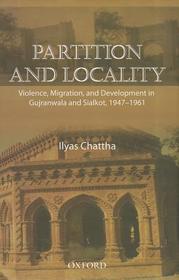
Partition and Locality
Violence, Migration, and Development in Gujranwala and Sialkot 1947-1961
- Publisher's listprice GBP 16.99
-
8 116 Ft (7 730 Ft + 5% VAT)
The price is estimated because at the time of ordering we do not know what conversion rates will apply to HUF / product currency when the book arrives. In case HUF is weaker, the price increases slightly, in case HUF is stronger, the price goes lower slightly.
- Discount 10% (cc. 812 Ft off)
- Discounted price 7 305 Ft (6 957 Ft + 5% VAT)
Subcribe now and take benefit of a favourable price.
Subscribe
8 116 Ft

Availability
Out of print
Why don't you give exact delivery time?
Delivery time is estimated on our previous experiences. We give estimations only, because we order from outside Hungary, and the delivery time mainly depends on how quickly the publisher supplies the book. Faster or slower deliveries both happen, but we do our best to supply as quickly as possible.
Product details:
- Publisher OUP Pakistan
- Date of Publication 19 May 2011
- ISBN 9780199061723
- Binding Hardback
- No. of pages350 pages
- Size 226x147x23 mm
- Weight 540 g
- Language English 0
Categories
Long description:
Partition and Locality provides original and challenging insights into the processes of violence, demographic transformation and physical reconstruction arising from the partition of the subcontinent in 1947. The focus is upon the cities of Gujranwala and Sialkot that experienced violence, demographic shift and economic transformation in different ways. The work is not only a significant contribution to the understanding of the partition process of British India and
its aftermath for the Pakistan Punjab, it also provide an authoritative and thought provoking approach to the themes of broader twentieth-century processes of collective violence, mass displacements and economic recovery. Drawing together fresh information from an array of unexploited sources, the
book not only questions wider interpretations of the patterns of partition violence, it also adds considerable evidential weight to the argument that partition violence cannot simply be dismissed as 'temporary madness' or aberration. The analysis goes beyond consideration of the violence in relation to its spontaneity and organizational character to represent an important contribution to knowledge by uncovering for the first time actual perpetrators of the violence in the region.
While Partition brought sufferings for many and disrupted old social, commercial and kin networks, the author concentrates particularly on new opportunities for both locals and refugees in different sectors of the economy arising from the migration of Hindu and Sikh business classes. The work highlights how the massive shifts in population influenced and transformed the socio-economic landscape of the two cities. The focus is upon the cities' post-independence industrial recovery and the
emergence of a new artisan-industrial class to prominence.
Table of Contents:
List of maps and illustrations
List of tables
Preface and acknowledgement
List of abbreviations
Glossary
Translations/transliterations
Introduction
Part I: Contexts: Historical and Provincial
Colonial Inheritance: Life before Partition in Gujranwala and Sialkot
Violence, Migration and Resettlement: Broader Punjab Level Picture
Part II: Locality, Violence and Migration
Partition Violence and Migration in Gujranwala
Partition Violence and Migration in Sialkot
Part III: Locality and the Aftermath of Partition
Refugee Resettlement and Development in Gujranwala
Refugee Resettlement and Development in Sialkot
Conclusion
Appendix
Bibliography
Index

