

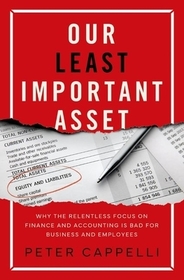
Our Least Important Asset
Why the Relentless Focus on Finance and Accounting is Bad for Business and Employees
-
10% KEDVEZMÉNY?
- A kedvezmény csak az 'Értesítés a kedvenc témákról' hírlevelünk címzettjeinek rendeléseire érvényes.
- Kiadói listaár GBP 23.99
-
11 461 Ft (10 915 Ft + 5% áfa)
Az ár azért becsült, mert a rendelés pillanatában nem lehet pontosan tudni, hogy a beérkezéskor milyen lesz a forint árfolyama az adott termék eredeti devizájához képest. Ha a forint romlana, kissé többet, ha javulna, kissé kevesebbet kell majd fizetnie.
- Kedvezmény(ek) 10% (cc. 1 146 Ft off)
- Kedvezményes ár 10 315 Ft (9 824 Ft + 5% áfa)
Iratkozzon fel most és részesüljön kedvezőbb árainkból!
Feliratkozom
11 461 Ft

Beszerezhetőség
Becsült beszerzési idő: Várható beérkezés: 2026. január vége.
A Prosperónál jelenleg nincsen raktáron.
Why don't you give exact delivery time?
A beszerzés időigényét az eddigi tapasztalatokra alapozva adjuk meg. Azért becsült, mert a terméket külföldről hozzuk be, így a kiadó kiszolgálásának pillanatnyi gyorsaságától is függ. A megadottnál gyorsabb és lassabb szállítás is elképzelhető, de mindent megteszünk, hogy Ön a lehető leghamarabb jusson hozzá a termékhez.
A termék adatai:
- Kiadó OUP USA
- Megjelenés dátuma 2023. december 18.
- ISBN 9780197629802
- Kötéstípus Keménykötés
- Terjedelem240 oldal
- Méret 236x165x24 mm
- Súly 481 g
- Nyelv angol 521
Kategóriák
Rövid leírás:
Why have jobs gotten so much worse? In Our Least Important Asset, Peter Cappelli argues that as financial accounting has become the guide for determining the success of companies, its inability to assess the reality of employment creates distortions and a short-sighted approach to management. In the process, employers undercut decades of evidence about what works to improve the quality, productivity, and creativity of workers. Drawing on decades of experience and research, Cappelli provides a comprehensive and insightful critique of the modern workplace, where the gaps in financial accounting make things worse for everyone, from employees to investors.
TöbbHosszú leírás:
A comprehensive and insightful look at the modern workplace and how employees are managed, where the new approach is driven by the quirks of financial accounting to the detriment of employees and the long-term success of the organization.
Real wages have stagnated or declined for most workers, job insecurity has increased, and retirement income is uncertain. Hours of work for white collar employees have increased steadily, opportunities for advancement have withered, and evidence of the negative effects of workplace stress on health continues to accumulate. Why have jobs gotten so much worse?
As Peter Cappelli argues, these issues are not a result of companies trying to be cost effective. They stem from the logic of financial accounting--the arbiter for determining whether a company is maximizing shareholder value--and its fundamental flaws in dealing with human capital. Financial accounting views employee costs as fixed costs that cannot be reduced and fails to account for the costs of bad employees and poor management. The simple goal of today's executives is to drive down employment costs, even if it raises costs elsewhere.
In Our Least Important Asset, Cappelli argues that the financial accounting problem explains many puzzling practices in contemporary management--employers' emphasis on costs per hire over the quality of hires, the replacement of regular employees with "leased" workers, the shift to unlimited vacations, and the transition of hiring responsibilities from professional recruiters to more expensive line managers. In the process, employers undercut all the evidence about what works to improve the quality, productivity, and creativity of workers. Drawing on decades of experience and research, Cappelli provides a comprehensive and insightful critique of the modern workplace where the gaps in financial accounting make things worse for everyone, from employees to investors.
...a timely study that connects present-day labor shortages to the dehumanizing irrationality of the modern workplace.
Tartalomjegyzék:
Preface
Introduction: The New Model and How We Got Here
Employment Practices Are Choices
Beyond Financial Accounting: What Drives Leaders
Hiring
The Rise of a New Industry and the Liquid Workforce
How Work Gets Done
The Impact on Employees
Final Thoughts
Notes
Index

