

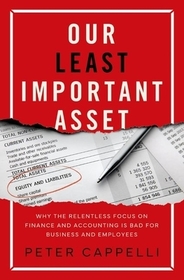
Our Least Important Asset
Why the Relentless Focus on Finance and Accounting is Bad for Business and Employees
- Publisher's listprice GBP 23.99
-
11 461 Ft (10 915 Ft + 5% VAT)
The price is estimated because at the time of ordering we do not know what conversion rates will apply to HUF / product currency when the book arrives. In case HUF is weaker, the price increases slightly, in case HUF is stronger, the price goes lower slightly.
- Discount 10% (cc. 1 146 Ft off)
- Discounted price 10 315 Ft (9 824 Ft + 5% VAT)
Subcribe now and take benefit of a favourable price.
Subscribe
11 461 Ft

Availability
Estimated delivery time: Expected time of arrival: end of January 2026.
Not in stock at Prospero.
Why don't you give exact delivery time?
Delivery time is estimated on our previous experiences. We give estimations only, because we order from outside Hungary, and the delivery time mainly depends on how quickly the publisher supplies the book. Faster or slower deliveries both happen, but we do our best to supply as quickly as possible.
Product details:
- Publisher OUP USA
- Date of Publication 18 December 2023
- ISBN 9780197629802
- Binding Hardback
- No. of pages240 pages
- Size 236x165x24 mm
- Weight 481 g
- Language English 521
Categories
Short description:
Why have jobs gotten so much worse? In Our Least Important Asset, Peter Cappelli argues that as financial accounting has become the guide for determining the success of companies, its inability to assess the reality of employment creates distortions and a short-sighted approach to management. In the process, employers undercut decades of evidence about what works to improve the quality, productivity, and creativity of workers. Drawing on decades of experience and research, Cappelli provides a comprehensive and insightful critique of the modern workplace, where the gaps in financial accounting make things worse for everyone, from employees to investors.
MoreLong description:
A comprehensive and insightful look at the modern workplace and how employees are managed, where the new approach is driven by the quirks of financial accounting to the detriment of employees and the long-term success of the organization.
Real wages have stagnated or declined for most workers, job insecurity has increased, and retirement income is uncertain. Hours of work for white collar employees have increased steadily, opportunities for advancement have withered, and evidence of the negative effects of workplace stress on health continues to accumulate. Why have jobs gotten so much worse?
As Peter Cappelli argues, these issues are not a result of companies trying to be cost effective. They stem from the logic of financial accounting--the arbiter for determining whether a company is maximizing shareholder value--and its fundamental flaws in dealing with human capital. Financial accounting views employee costs as fixed costs that cannot be reduced and fails to account for the costs of bad employees and poor management. The simple goal of today's executives is to drive down employment costs, even if it raises costs elsewhere.
In Our Least Important Asset, Cappelli argues that the financial accounting problem explains many puzzling practices in contemporary management--employers' emphasis on costs per hire over the quality of hires, the replacement of regular employees with "leased" workers, the shift to unlimited vacations, and the transition of hiring responsibilities from professional recruiters to more expensive line managers. In the process, employers undercut all the evidence about what works to improve the quality, productivity, and creativity of workers. Drawing on decades of experience and research, Cappelli provides a comprehensive and insightful critique of the modern workplace where the gaps in financial accounting make things worse for everyone, from employees to investors.
...a timely study that connects present-day labor shortages to the dehumanizing irrationality of the modern workplace.
Table of Contents:
Preface
Introduction: The New Model and How We Got Here
Employment Practices Are Choices
Beyond Financial Accounting: What Drives Leaders
Hiring
The Rise of a New Industry and the Liquid Workforce
How Work Gets Done
The Impact on Employees
Final Thoughts
Notes
Index

