

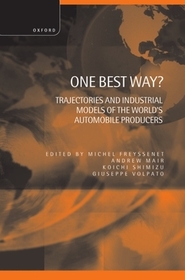
One Best Way?
Trajectories and Industrial Models of the World's Automobile Producers
-
10% KEDVEZMÉNY?
- A kedvezmény csak az 'Értesítés a kedvenc témákról' hírlevelünk címzettjeinek rendeléseire érvényes.
- Kiadói listaár GBP 92.00
-
41 538 Ft (39 560 Ft + 5% áfa)
Az ár azért becsült, mert a rendelés pillanatában nem lehet pontosan tudni, hogy a beérkezéskor milyen lesz a forint árfolyama az adott termék eredeti devizájához képest. Ha a forint romlana, kissé többet, ha javulna, kissé kevesebbet kell majd fizetnie.
- Kedvezmény(ek) 10% (cc. 4 154 Ft off)
- Kedvezményes ár 37 384 Ft (35 604 Ft + 5% áfa)
Iratkozzon fel most és részesüljön kedvezőbb árainkból!
Feliratkozom
41 538 Ft

Beszerezhetőség
Megrendelésre a kiadó utánnyomja a könyvet. Rendelhető, de a szokásosnál kicsit lassabban érkezik meg.
Why don't you give exact delivery time?
A beszerzés időigényét az eddigi tapasztalatokra alapozva adjuk meg. Azért becsült, mert a terméket külföldről hozzuk be, így a kiadó kiszolgálásának pillanatnyi gyorsaságától is függ. A megadottnál gyorsabb és lassabb szállítás is elképzelhető, de mindent megteszünk, hogy Ön a lehető leghamarabb jusson hozzá a termékhez.
A termék adatai:
- Kiadó OUP Oxford
- Megjelenés dátuma 1998. november 26.
- ISBN 9780198290896
- Kötéstípus Keménykötés
- Terjedelem494 oldal
- Méret 242x162x31 mm
- Súly 824 g
- Nyelv angol
- Illusztrációk numerous tables 0
Kategóriák
Rövid leírás:
Since the late 1960s, the world's automobile producers have been borrowing, or inventing solutions to problems. Japanese management techniques have been much studied and copied, particularly the model of 'lean production'. In this book, experts from different countries compare and contrast the strategic and organizational solutions of the major producers in North America, Europe, and Japan over the past three decades.
TöbbHosszú leírás:
Many argue that the sole viable future for the automobile industry - indeed for all industry - is the adoption of `lean production' as an organizational model. One Best Way? brings together the research of academic specialists in the automobile industry who have analysed the evolution of 15 major Asian, North American, and European companies in terms of their technological, organizational, commercial and social `trajectories'. They look closely at the evidence for `one best way' and argue that it is more useful to assess the distinctive challenges and `trajectories' that companies have pursued as they try to optimize their profit-making capacities. The book present detailed descriptions of the major producers around the world in three sections:
Asia: Toyota, Nissan, Honda, Mitsubishi, Hyundai
North America: General Motors, Ford, Chrysler
Europe: Peugeot, Renault, Rover, Mercedes, Volvo, Lada
The book will be essential reading and reference for academics, researchers, and analysts worldwide wanting to track the course of the automobile industry and assess the merits of `lean production'.
Tartalomjegyzék:
Introduction
Intersecting Trajectories and Model Changes
Models, Trajectories, and the Evolution of Production Systems: Lessons from the American Automobile Industry in the Years Between the Wars
Part I. Only One Model in Japan?
New Toyotaism?
Nissan: Restructuring to Regain Competitiveness
The Globalization of Honda's Product-Led Flexible Mass Production System
The Unique Trajectory of Mitsubishi Motors
Hyundai Tries Two Industrial Models to Penetrate Global Markets
Part II. Three Distinct Trajectories at North America's Big Three
The General-Motors Trajectory: Strategic Shift or Tactical Drift?
Globalization at the Heart of Organizational Change: Crisis and Recovery at the Ford Motor Company
Re-Inventing Chrysler
Part III. Europe's Dilemma: The Original Conditions of Industrial Model's Viability
The Development of Volkswagen's Industrial Model, 1967-1995
Making Manufacturing Lean in the Italian Automobile Industry: The Trajectory of Fiat
Peugeot Meets Ford, Sloan, and Toyota
Renault: From Diversified Mass Production to Innovative Flexible Production
From British Leyland Motor Corporation to Rover Group: The Search for a Viable British Model
A Second Comeback or a Final Farewell? The Volvo Trajectory, 1973-1994
Lada: Viability of Fordism?
Conclusion: The Choices to be made in the Coming Decade

