

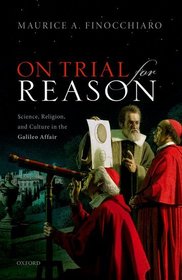
On Trial For Reason
Science, Religion, and Culture in the Galileo Affair
-
10% KEDVEZMÉNY?
- A kedvezmény csak az 'Értesítés a kedvenc témákról' hírlevelünk címzettjeinek rendeléseire érvényes.
- Kiadói listaár GBP 33.99
-
15 346 Ft (14 615 Ft + 5% áfa)
Az ár azért becsült, mert a rendelés pillanatában nem lehet pontosan tudni, hogy a beérkezéskor milyen lesz a forint árfolyama az adott termék eredeti devizájához képest. Ha a forint romlana, kissé többet, ha javulna, kissé kevesebbet kell majd fizetnie.
- Kedvezmény(ek) 10% (kb. 1 535 Ft)
- Kedvezményes ár 13 811 Ft (13 154 Ft + 5% áfa)
Iratkozzon fel most és részesüljön kedvezőbb árainkból!
Feliratkozom
15 346 Ft

Beszerezhetőség
Megrendelésre a kiadó utánnyomja a könyvet. Rendelhető, de a szokásosnál kicsit lassabban érkezik meg.
Why don't you give exact delivery time?
A beszerzés időigényét az eddigi tapasztalatokra alapozva adjuk meg. Azért becsült, mert a terméket külföldről hozzuk be, így a kiadó kiszolgálásának pillanatnyi gyorsaságától is függ. A megadottnál gyorsabb és lassabb szállítás is elképzelhető, de mindent megteszünk, hogy Ön a lehető leghamarabb jusson hozzá a termékhez.
A termék adatai:
- Kiadó OUP Oxford
- Megjelenés dátuma 2019. szeptember 26.
- ISBN 9780198797920
- Kötéstípus Keménykötés
- Terjedelem300 oldal
- Méret 241x159x26 mm
- Súly 532 g
- Nyelv angol
- Illusztrációk 22 black and white images 0
Kategóriák
Rövid leírás:
Maurice Finocchiaro considers the trial of Galileo by the Roman Inquisition in 1633, weighing up the views of both sides and presenting an account that incorporates historical context, science, theology, and philosophy. He also considers the legacy and continuing cultural afterlife of this remarkable episode in the history of science.
TöbbHosszú leírás:
In 1633 the Roman Inquisition condemned Galileo as a suspected heretic for defending the astronomical theory that the earth moves, and implicitly assuming the theological principle that Scripture is not scientific authority. This controversial event has sent ripples down the centuries, embodying the struggle between a thinker who came to be regarded as the Father of Modern Science, and an institution that is both one of the world's greatest religions and most ancient organizations. The trial has been cited both as a clear demonstration of the incompatibility between science and religion, and also a stunning exemplar of rationality, scientific method, and critical thinking.
Much has been written about Galileo's trial, but most works argue from a particular point of view - that of secular science against the Church, or justifying the religious position. Maurice Finocchiaro aims to provide a balanced historical account that draws out the cultural nuances. Unfolding the intriguing narrative of Galileo's trial, he sets it against its contemporary intellectual and philosophical background. In particular, Finocchiaro focuses on the contemporary arguments and evidence for and against the Earth's motion, which were based on astronomical observation, the physics of motion, philosophical principles about the nature of knowledge, and theological principles about the authority and the interpretation of Scripture. Following both sides of the controversy and its far-reaching philosophical impact, Finocchiaro unravels the complex relationship between science and religion, and demonstrates how Galileo came to be recognised as a model of logical reasoning.
Students of early modern science are indebted to Maurice Finocchiaro for his lifetime of scholarly effort relating to the work of Galileo ... this latest work is also welcome, providing a readable summary of the main issues at stake in the Galileo affair and of Finocchiaro's defence of Galileo's reasoning. I say 'defence' because ... While his latest book exemplifies the even-handedness he praises in the work of his seventeenth-century hero, it nevertheless constitutes a vigorous defence of both Galileo's approach to the scientific enterprise and his attempts to separate science and religion.
Tartalomjegyzék:
Preface and Acknowledgments
Introduction: Avoiding Myths and Muddles
When the Earth Stood Still
The Copernican Controversy (1543-1609)
Re-assessing Copernicanism (1609-1616)
The Earlier Inquisition Proceedings (1615-1616)
The Dialogue on the Two Chief World Systems (1632)
The Inquisition Trial (1632-1633)
Becoming a Cultural Icon (1616-2016)
Religion vs. Science?
A Model of Critical Thinking?
Some Final Thoughts
Further Reading and Cited Works
Notes

