

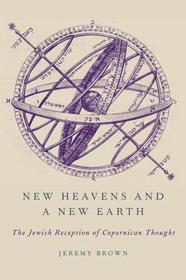
New Heavens and a New Earth
The Jewish Reception of Copernican Thought
-
10% KEDVEZMÉNY?
- A kedvezmény csak az 'Értesítés a kedvenc témákról' hírlevelünk címzettjeinek rendeléseire érvényes.
- Kiadói listaár GBP 127.50
-
57 566 Ft (54 825 Ft + 5% áfa)
Az ár azért becsült, mert a rendelés pillanatában nem lehet pontosan tudni, hogy a beérkezéskor milyen lesz a forint árfolyama az adott termék eredeti devizájához képest. Ha a forint romlana, kissé többet, ha javulna, kissé kevesebbet kell majd fizetnie.
- Kedvezmény(ek) 10% (kb. 5 756 Ft)
- Kedvezményes ár 51 810 Ft (49 343 Ft + 5% áfa)
Iratkozzon fel most és részesüljön kedvezőbb árainkból!
Feliratkozom
57 566 Ft

Beszerezhetőség
Megrendelésre a kiadó utánnyomja a könyvet. Rendelhető, de a szokásosnál kicsit lassabban érkezik meg.
Why don't you give exact delivery time?
A beszerzés időigényét az eddigi tapasztalatokra alapozva adjuk meg. Azért becsült, mert a terméket külföldről hozzuk be, így a kiadó kiszolgálásának pillanatnyi gyorsaságától is függ. A megadottnál gyorsabb és lassabb szállítás is elképzelhető, de mindent megteszünk, hogy Ön a lehető leghamarabb jusson hozzá a termékhez.
A termék adatai:
- Kiadó OUP USA
- Megjelenés dátuma 2013. június 13.
- ISBN 9780199754793
- Kötéstípus Keménykötés
- Terjedelem416 oldal
- Méret 160x236x27 mm
- Súly 726 g
- Nyelv angol
- Illusztrációk 2 color halftones; 24 black and white halftones and line drawings 0
Kategóriák
Rövid leírás:
Jeremy Brown offers the first major study of the Jewish reception of the Copernican revolution, examining four hundred years of Jewish writings on the Copernican model. Brown shows the ways in which Jews ignored, rejected, or accepted the Copernican model, and the theological and societal underpinnings of their choices.
TöbbHosszú leírás:
Jeremy Brown offers the first major study of the Jewish reception of the Copernican revolution, examining four hundred years of Jewish writings on the Copernican model. Brown shows the ways in which Jews ignored, rejected, or accepted the Copernican model, and the theological and societal underpinnings of their choices.
Throughout New Heavens and a New Earth are deft historical studies of such colorful figures as Joseph Delmedigo, the first Jewish Copernican and a student of Galileo's; Tuviah Cohen, who called Copernicus the "Son of Satan; " Zelig Slonimski, author of a famed collection of essays on Halley's Comet and other astronomical phenomena; and the modern neo-goecentrists who use Einstein's Theory of Relativity to argue that the Earth does not actually revolve around the sun. Brown also provides insightful comparisons of concurrent Jewish and Christian writings on Copernicus, demonstrating that the Jewish reception of Copernicus was largely dependent on local factors and response.
The book concludes by noting the important lessons that may be learned from the history of the Jewish reception of Copernican thought and showing how religions make room for new scientific descriptions of reality while upholding most cherished beliefs.
Brown has provided a major work of historical scholarship which is sure to provide a vital point of reference in the science-religion debate for years to come.
Tartalomjegyzék:
Introduction
Chapter 1 - Nicolas Copernicus and His Revolution
Chapter 2 - The Talmudic View of the Universe
Chapter 3 - David Gans and the First Mention of Copernicus in Hebrew Literature
Chapter 4 - The First Jewish Copernican: Rabbi Joseph Solomon Delmedigo
Chapter 5 - ''Copernicus Is the Son of Satan.'' The First Jewish Rejections of Copernicus
Chapter 6 - David Nieto and Copernicanism in London
Chapter 7 - The Jewish Encyclopedias
Chapter 8 - The Eighteenth Century. Jews and Copernicus in the Newtonian Era
Chapter 9 - ''I Have Written a Book For the Young People.'' David Friesenhausen's Mosdot Tevel
Chapter 10 - The Nineteenth Century: Copernicus Without Hesitation
Chapter 11 - ''Let Copernicus and a Thousand Like Him Be Removed From the World.'' Reuven Landau's Rejection
Chapter 12 - The Modern Period
Chapter 13 - Relativity and Contemporary Jewish Geocentrists
Chapter 14 - Conclusions
Appendix
Bibliography

