

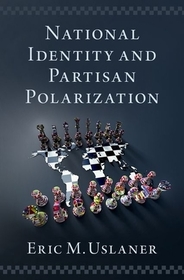
National Identity and Partisan Polarization
-
20% KEDVEZMÉNY?
- A kedvezmény csak az 'Értesítés a kedvenc témákról' hírlevelünk címzettjeinek rendeléseire érvényes.
- Kiadói listaár GBP 55.00
-
24 832 Ft (23 650 Ft + 5% áfa)
Az ár azért becsült, mert a rendelés pillanatában nem lehet pontosan tudni, hogy a beérkezéskor milyen lesz a forint árfolyama az adott termék eredeti devizájához képest. Ha a forint romlana, kissé többet, ha javulna, kissé kevesebbet kell majd fizetnie.
- Kedvezmény(ek) 20% (cc. 4 966 Ft off)
- Kedvezményes ár 19 866 Ft (18 920 Ft + 5% áfa)
- A kedvezmény érvényes eddig: 2026. június 30.
Iratkozzon fel most és részesüljön kedvezőbb árainkból!
Feliratkozom
24 832 Ft

Beszerezhetőség
Becsült beszerzési idő: A Prosperónál jelenleg nincsen raktáron, de a kiadónál igen. Beszerzés kb. 3-5 hét..
A Prosperónál jelenleg nincsen raktáron.
Why don't you give exact delivery time?
A beszerzés időigényét az eddigi tapasztalatokra alapozva adjuk meg. Azért becsült, mert a terméket külföldről hozzuk be, így a kiadó kiszolgálásának pillanatnyi gyorsaságától is függ. A megadottnál gyorsabb és lassabb szállítás is elképzelhető, de mindent megteszünk, hogy Ön a lehető leghamarabb jusson hozzá a termékhez.
A termék adatai:
- Kiadó OUP USA
- Megjelenés dátuma 2023. március 16.
- ISBN 9780197633946
- Kötéstípus Keménykötés
- Terjedelem192 oldal
- Méret 162x243x18 mm
- Súly 431 g
- Nyelv angol 287
Kategóriák
Rövid leírás:
In National Identity and Partisan Polarization, Eric M. Uslaner examines how national identity has become a central issue in political and social life across the world. Questions of identity--who should be counted as a "true member" of a society and who deserves assistance from the government--have displaced other social and economic issues across nations in many countries. This study considers the role of identity theoretically and in the United State, the United Kingdom, France, Austria, Germany, Sweden, Hungary, Poland, Israel, and Taiwan.
TöbbHosszú leírás:
National Identity Identity and Partisan Polarization examines how national identity has become a central issue in political and social life across the world. Questions of identity--who should be counted as a "true member" of a society and who deserves assistance from the government--have displaced other social and economic issues across nations in many countries.
This study considers the role of identity theoretically and in the United States, the United Kingdom, France, Austria, Germany, Sweden, Hungary, Poland, Israel, and Taiwan. Identity varies over time and over countries. Some such as Sweden have a more "inclusive" sense of identity--one does not need to be born in the country or have ancestry to be considered a "true Swede." Other countries, such as Austria, France, Hungary, Poland, Israel, and Taiwan, have a more "exclusive" notion of identity--where one was born and a common heritage (race, religion, ethnicity) are seen as essential for seeing others as "true" members of society. "Outsiders" are viewed negatively, often as threatening a national culture and not deserving of government assistance. In the United States, the United Kingdom, and France, the major political parties take opposing positions on identity. In the United States and the United Kingdom, issues of identity have become highly correlated (polarized) with social and economic issues. In the former Communist countries of Hungary and Poland, the dominant parties have taken nationalist positions on identity but favor generous welfare policies for people of their own background. In Israel and Taiwan, social and economic issues have become less important than nationalism.
There is no doubt this is a hugely important book. In the current era, there is an urgent need to understand better why a feeling of national identity seems such a powerful attitude. This volume brings everything together to arrive at this understanding. It offers the accumulation of a lifetime of profound scholarly work. The combination of historical evidence and a profound knowledge of data and statistical analysis is more than impressive. This book brings also a powerful moral message: it demonstrates how important education, and the universal access to education are. The evidence, assembled in this volume is just overwhelming and conclusive; and it sheds new light on current debates. Uslaner shows in this volume what political science can do, based on rigorous methods, and how this work can lead to a more just society. Maybe that is the most important contribution political science has to offer.
Tartalomjegyzék:
Preface
Chapter 1: Introduction
Chapter 2: The United States
Chapter 3: The United Kingdom
Chapter 4: France
Chapter 5: Germany and Austria
Chapter 6: Sweden
Chapter 7: Central and Eastern Europe
Chapter 8: Israel and Taiwan
Chapter 9: Deservingness
Chapter 10: Reprise
References
Index

