

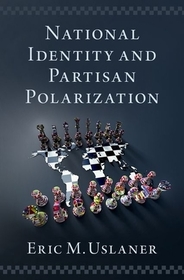
National Identity and Partisan Polarization
- Publisher's listprice GBP 55.00
-
24 832 Ft (23 650 Ft + 5% VAT)
The price is estimated because at the time of ordering we do not know what conversion rates will apply to HUF / product currency when the book arrives. In case HUF is weaker, the price increases slightly, in case HUF is stronger, the price goes lower slightly.
- Discount 20% (cc. 4 966 Ft off)
- Discounted price 19 866 Ft (18 920 Ft + 5% VAT)
- Discount is valid until: 30 June 2026
Subcribe now and take benefit of a favourable price.
Subscribe
24 832 Ft

Availability
Estimated delivery time: In stock at the publisher, but not at Prospero's office. Delivery time approx. 3-5 weeks.
Not in stock at Prospero.
Why don't you give exact delivery time?
Delivery time is estimated on our previous experiences. We give estimations only, because we order from outside Hungary, and the delivery time mainly depends on how quickly the publisher supplies the book. Faster or slower deliveries both happen, but we do our best to supply as quickly as possible.
Product details:
- Publisher OUP USA
- Date of Publication 16 March 2023
- ISBN 9780197633946
- Binding Hardback
- No. of pages192 pages
- Size 162x243x18 mm
- Weight 431 g
- Language English 287
Categories
Short description:
In National Identity and Partisan Polarization, Eric M. Uslaner examines how national identity has become a central issue in political and social life across the world. Questions of identity--who should be counted as a "true member" of a society and who deserves assistance from the government--have displaced other social and economic issues across nations in many countries. This study considers the role of identity theoretically and in the United State, the United Kingdom, France, Austria, Germany, Sweden, Hungary, Poland, Israel, and Taiwan.
MoreLong description:
National Identity Identity and Partisan Polarization examines how national identity has become a central issue in political and social life across the world. Questions of identity--who should be counted as a "true member" of a society and who deserves assistance from the government--have displaced other social and economic issues across nations in many countries.
This study considers the role of identity theoretically and in the United States, the United Kingdom, France, Austria, Germany, Sweden, Hungary, Poland, Israel, and Taiwan. Identity varies over time and over countries. Some such as Sweden have a more "inclusive" sense of identity--one does not need to be born in the country or have ancestry to be considered a "true Swede." Other countries, such as Austria, France, Hungary, Poland, Israel, and Taiwan, have a more "exclusive" notion of identity--where one was born and a common heritage (race, religion, ethnicity) are seen as essential for seeing others as "true" members of society. "Outsiders" are viewed negatively, often as threatening a national culture and not deserving of government assistance. In the United States, the United Kingdom, and France, the major political parties take opposing positions on identity. In the United States and the United Kingdom, issues of identity have become highly correlated (polarized) with social and economic issues. In the former Communist countries of Hungary and Poland, the dominant parties have taken nationalist positions on identity but favor generous welfare policies for people of their own background. In Israel and Taiwan, social and economic issues have become less important than nationalism.
There is no doubt this is a hugely important book. In the current era, there is an urgent need to understand better why a feeling of national identity seems such a powerful attitude. This volume brings everything together to arrive at this understanding. It offers the accumulation of a lifetime of profound scholarly work. The combination of historical evidence and a profound knowledge of data and statistical analysis is more than impressive. This book brings also a powerful moral message: it demonstrates how important education, and the universal access to education are. The evidence, assembled in this volume is just overwhelming and conclusive; and it sheds new light on current debates. Uslaner shows in this volume what political science can do, based on rigorous methods, and how this work can lead to a more just society. Maybe that is the most important contribution political science has to offer.
Table of Contents:
Preface
Chapter 1: Introduction
Chapter 2: The United States
Chapter 3: The United Kingdom
Chapter 4: France
Chapter 5: Germany and Austria
Chapter 6: Sweden
Chapter 7: Central and Eastern Europe
Chapter 8: Israel and Taiwan
Chapter 9: Deservingness
Chapter 10: Reprise
References
Index

