

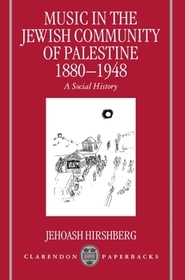
Music in the Jewish Community of Palestine 1880-1948
A Social History
Sorozatcím: Clarendon Paperbacks;
-
10% KEDVEZMÉNY?
- A kedvezmény csak az 'Értesítés a kedvenc témákról' hírlevelünk címzettjeinek rendeléseire érvényes.
- Kiadói listaár GBP 47.99
-
21 667 Ft (20 635 Ft + 5% áfa)
Az ár azért becsült, mert a rendelés pillanatában nem lehet pontosan tudni, hogy a beérkezéskor milyen lesz a forint árfolyama az adott termék eredeti devizájához képest. Ha a forint romlana, kissé többet, ha javulna, kissé kevesebbet kell majd fizetnie.
- Kedvezmény(ek) 10% (cc. 2 167 Ft off)
- Kedvezményes ár 19 500 Ft (18 572 Ft + 5% áfa)
Iratkozzon fel most és részesüljön kedvezőbb árainkból!
Feliratkozom
21 667 Ft

Beszerezhetőség
Megrendelésre a kiadó utánnyomja a könyvet. Rendelhető, de a szokásosnál kicsit lassabban érkezik meg.
Why don't you give exact delivery time?
A beszerzés időigényét az eddigi tapasztalatokra alapozva adjuk meg. Azért becsült, mert a terméket külföldről hozzuk be, így a kiadó kiszolgálásának pillanatnyi gyorsaságától is függ. A megadottnál gyorsabb és lassabb szállítás is elképzelhető, de mindent megteszünk, hogy Ön a lehető leghamarabb jusson hozzá a termékhez.
A termék adatai:
- Kiadó Clarendon Press
- Megjelenés dátuma 1996. október 17.
- ISBN 9780198166511
- Kötéstípus Puhakötés
- Terjedelem310 oldal
- Méret 235x157x18 mm
- Súly 445 g
- Nyelv angol
- Illusztrációk music examples, 1 map 0
Kategóriák
Rövid leírás:
A social history of the music of the Jewish community in Palestine from the beginnings of Jewish immigration to Palestine in 1880 to the declaration of the State of Israel in 1948.
TöbbHosszú leírás:
This book presents a social history of the music of the Jewish community in Palestine from the beginnings of Jewish immigration to Palestine in 1880 to the declaration of the State of Israel in 1948. The story is a fascinating case study of a small society of immigrants and refugees who established an internationally recognized professional musical establishment against the backdrop of two world wars, the absorption of successive waves of immigrants, local skirmishes, and a full-scale national war. Though under Ottoman and later British rule, Jewish society in Palestine was virtually autonomous in cultural matters; its musical culture struggled for a balance between a transplanted European heritage and a powerful, ideologically driven desire to find inspiration from the East. Professor Hirshberg opens with a description of music in Palestine under Ottoman rule, and then proceeds to chart the momentous history of the next 70 years in a broadly chronological framework. His final chapters centre on the broad array of ideological and social polemics which dominated the musical scene for the entire period. As such, his book will be of interest not only to music historians (especially those interested in national schools and in twentieth-century music), but also to social historians, cultural anthropologists, and historians of contemporary Jewry.
This is a fascinating account of the development of music, and, perhaps even more, of musical institutions, in the area that became the State of Israel in 1948 ... Altogether, this is a well-written, well-researched volume of interest not only to those working with Jewish and Middle Eastern music, but also to anyone concerned with how an emerging nation develops and establishes its identity, and how that identity is bound up with music at all levels.

