

- Publisher's listprice GBP 47.99
-
21 667 Ft (20 635 Ft + 5% VAT)
The price is estimated because at the time of ordering we do not know what conversion rates will apply to HUF / product currency when the book arrives. In case HUF is weaker, the price increases slightly, in case HUF is stronger, the price goes lower slightly.
- Discount 10% (cc. 2 167 Ft off)
- Discounted price 19 500 Ft (18 572 Ft + 5% VAT)
Subcribe now and take benefit of a favourable price.
Subscribe
21 667 Ft

Availability
printed on demand
Why don't you give exact delivery time?
Delivery time is estimated on our previous experiences. We give estimations only, because we order from outside Hungary, and the delivery time mainly depends on how quickly the publisher supplies the book. Faster or slower deliveries both happen, but we do our best to supply as quickly as possible.
Product details:
- Publisher Clarendon Press
- Date of Publication 17 October 1996
- ISBN 9780198166511
- Binding Paperback
- No. of pages310 pages
- Size 235x157x18 mm
- Weight 445 g
- Language English
- Illustrations music examples, 1 map 0
Categories
Short description:
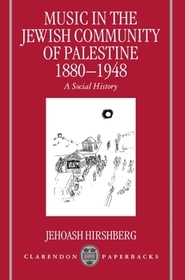
A social history of the music of the Jewish community in Palestine from the beginnings of Jewish immigration to Palestine in 1880 to the declaration of the State of Israel in 1948.
MoreLong description:
This book presents a social history of the music of the Jewish community in Palestine from the beginnings of Jewish immigration to Palestine in 1880 to the declaration of the State of Israel in 1948. The story is a fascinating case study of a small society of immigrants and refugees who established an internationally recognized professional musical establishment against the backdrop of two world wars, the absorption of successive waves of immigrants, local skirmishes, and a full-scale national war. Though under Ottoman and later British rule, Jewish society in Palestine was virtually autonomous in cultural matters; its musical culture struggled for a balance between a transplanted European heritage and a powerful, ideologically driven desire to find inspiration from the East. Professor Hirshberg opens with a description of music in Palestine under Ottoman rule, and then proceeds to chart the momentous history of the next 70 years in a broadly chronological framework. His final chapters centre on the broad array of ideological and social polemics which dominated the musical scene for the entire period. As such, his book will be of interest not only to music historians (especially those interested in national schools and in twentieth-century music), but also to social historians, cultural anthropologists, and historians of contemporary Jewry.
This is a fascinating account of the development of music, and, perhaps even more, of musical institutions, in the area that became the State of Israel in 1948 ... Altogether, this is a well-written, well-researched volume of interest not only to those working with Jewish and Middle Eastern music, but also to anyone concerned with how an emerging nation develops and establishes its identity, and how that identity is bound up with music at all levels.

