

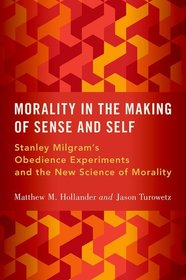
Morality in the Making of Sense and Self
Stanley Milgram's Obedience Experiments and the New Science of Morality
-
10% KEDVEZMÉNY?
- A kedvezmény csak az 'Értesítés a kedvenc témákról' hírlevelünk címzettjeinek rendeléseire érvényes.
- Kiadói listaár GBP 57.00
-
25 735 Ft (24 510 Ft + 5% áfa)
Az ár azért becsült, mert a rendelés pillanatában nem lehet pontosan tudni, hogy a beérkezéskor milyen lesz a forint árfolyama az adott termék eredeti devizájához képest. Ha a forint romlana, kissé többet, ha javulna, kissé kevesebbet kell majd fizetnie.
- Kedvezmény(ek) 10% (kb. 2 573 Ft)
- Kedvezményes ár 23 162 Ft (22 059 Ft + 5% áfa)
Iratkozzon fel most és részesüljön kedvezőbb árainkból!
Feliratkozom
25 735 Ft

Beszerezhetőség
Becsült beszerzési idő: A Prosperónál jelenleg nincsen raktáron, de a kiadónál igen. Beszerzés kb. 3-5 hét..
A Prosperónál jelenleg nincsen raktáron.
Why don't you give exact delivery time?
A beszerzés időigényét az eddigi tapasztalatokra alapozva adjuk meg. Azért becsült, mert a terméket külföldről hozzuk be, így a kiadó kiszolgálásának pillanatnyi gyorsaságától is függ. A megadottnál gyorsabb és lassabb szállítás is elképzelhető, de mindent megteszünk, hogy Ön a lehető leghamarabb jusson hozzá a termékhez.
A termék adatai:
- Kiadó OUP USA
- Megjelenés dátuma 2024. február 5.
- ISBN 9780190096045
- Kötéstípus Keménykötés
- Terjedelem264 oldal
- Méret 162x243x24 mm
- Súly 494 g
- Nyelv angol
- Illusztrációk 2 text boxes; 7 tables 460
Kategóriák
Rövid leírás:
This book offers a new explanation of obedience and defiance in Milgram's lab. Examining one of the largest collections of Milgram's original audiotapes, Hollander and Turowetz scrutinize participant behavior in not only the experiments themselves, but also recordings of the subsequent debriefing interviews in which participants were asked to reflect on their actions. Introducing an original theoretical framework in the sociology of morality, they show that, contrary to traditional understandings of Milgram's experiments that highlight obedience, virtually all subjects, both compliant and defiant, mobilized practices to resist the authority's commands. By illuminating the relationship between concrete moral dilemmas and social interaction, Hollander and Turowetz tell a new, empirically-grounded story about Milgram: one about morality-and immorality-in the making of sense and self.
TöbbHosszú leírás:
For over half a century, Stanley Milgram's classic and controversial obedience experiments have been a touchstone in the social and behavioral sciences, introducing generations of students to the concept of destructive obedience to authority and the Holocaust. In the last decade, the interdisciplinary Milgram renaissance has led to widespread interest in rethinking and challenging the context and nature of his Obedience Experiment.
In Morality in the Making of Sense and Self, Matthew M. Hollander and Jason Turowetz offer a new explanation of obedience and defiance in Milgram's lab. Examining one of the largest collections of Milgram's original audiotapes, they scrutinize participant behavior in not only the experiments themselves, but also recordings of the subsequent debriefing interviews in which participants were asked to reflect on their actions. Introducing an original theoretical framework in the sociology of morality, they show that, contrary to traditional understandings of Milgram's experiments that highlight obedience, virtually all subjects, both compliant and defiant, mobilized practices to resist the authority's commands, such that all were obedient and disobedient to varying degrees. As Hollander and Turowetz show, the precise ways subjects worked out a definition of the situation shaped the choices open to them, how they responded to the authority's demands, and ultimately whether they would be classified as "obedient" or "defiant."
By illuminating the relationship between concrete moral dilemmas and social interaction, Hollander and Turowetz tell a new, empirically-grounded story about Milgram: one about morality--and immorality--in the making of sense and self.
This book makes important contributions to both the sociology of morality and Milgram scholarship. The sociology of morality tends to treat the products of interaction—sense and self—as its antecedents, overlooking the social processes that constitute morality. Through close examination of interaction in Milgram's experiments, Hollander and Turowetz show that his experimental context similarly depends on collaborative orders of sensemaking that were left out of the analysis. Like the sociology of morality, Milgram's account of his experiments erased the practices that comprised them—making it seem as if participants willingly obeyed orders to hurt others when they had actually resisted and made appeals to morality.
Tartalomjegyzék:
Preface
Introduction: Morality and Milgram
Part I. The Moral Order of Interaction
Chapter 1. Moral Science and the Milgram Paradigm
Chapter 2. Morality in the Making of Sense and Self
Part II. Morality in Milgram's Lab: Interaction During the Experiment
Chapter 3. Situated Moral Practice: Resistance in Milgram's Lab
Chapter 4. Forms of Milgramesque Resistance
Chapter 5. Self- and Other-Attentive Resistance
Part III. Current Debates: Interaction in the Post-Experiment Interview
Chapter 6. Explaining Milgramesque Behaviors
Chapter 7. Milgram, Science, and Morality
Chapter 8. Conclusion
Appendix 1: Data and Methodology
Appendix 2: Transcription Conventions
References
Index

