

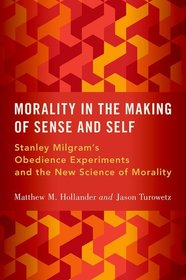
Morality in the Making of Sense and Self
Stanley Milgram's Obedience Experiments and the New Science of Morality
- Publisher's listprice GBP 57.00
-
25 735 Ft (24 510 Ft + 5% VAT)
The price is estimated because at the time of ordering we do not know what conversion rates will apply to HUF / product currency when the book arrives. In case HUF is weaker, the price increases slightly, in case HUF is stronger, the price goes lower slightly.
- Discount 10% (cc. 2 573 Ft off)
- Discounted price 23 162 Ft (22 059 Ft + 5% VAT)
Subcribe now and take benefit of a favourable price.
Subscribe
25 735 Ft

Availability
Estimated delivery time: In stock at the publisher, but not at Prospero's office. Delivery time approx. 3-5 weeks.
Not in stock at Prospero.
Why don't you give exact delivery time?
Delivery time is estimated on our previous experiences. We give estimations only, because we order from outside Hungary, and the delivery time mainly depends on how quickly the publisher supplies the book. Faster or slower deliveries both happen, but we do our best to supply as quickly as possible.
Product details:
- Publisher OUP USA
- Date of Publication 5 February 2024
- ISBN 9780190096045
- Binding Hardback
- No. of pages264 pages
- Size 162x243x24 mm
- Weight 494 g
- Language English
- Illustrations 2 text boxes; 7 tables 460
Categories
Short description:
This book offers a new explanation of obedience and defiance in Milgram's lab. Examining one of the largest collections of Milgram's original audiotapes, Hollander and Turowetz scrutinize participant behavior in not only the experiments themselves, but also recordings of the subsequent debriefing interviews in which participants were asked to reflect on their actions. Introducing an original theoretical framework in the sociology of morality, they show that, contrary to traditional understandings of Milgram's experiments that highlight obedience, virtually all subjects, both compliant and defiant, mobilized practices to resist the authority's commands. By illuminating the relationship between concrete moral dilemmas and social interaction, Hollander and Turowetz tell a new, empirically-grounded story about Milgram: one about morality-and immorality-in the making of sense and self.
MoreLong description:
For over half a century, Stanley Milgram's classic and controversial obedience experiments have been a touchstone in the social and behavioral sciences, introducing generations of students to the concept of destructive obedience to authority and the Holocaust. In the last decade, the interdisciplinary Milgram renaissance has led to widespread interest in rethinking and challenging the context and nature of his Obedience Experiment.
In Morality in the Making of Sense and Self, Matthew M. Hollander and Jason Turowetz offer a new explanation of obedience and defiance in Milgram's lab. Examining one of the largest collections of Milgram's original audiotapes, they scrutinize participant behavior in not only the experiments themselves, but also recordings of the subsequent debriefing interviews in which participants were asked to reflect on their actions. Introducing an original theoretical framework in the sociology of morality, they show that, contrary to traditional understandings of Milgram's experiments that highlight obedience, virtually all subjects, both compliant and defiant, mobilized practices to resist the authority's commands, such that all were obedient and disobedient to varying degrees. As Hollander and Turowetz show, the precise ways subjects worked out a definition of the situation shaped the choices open to them, how they responded to the authority's demands, and ultimately whether they would be classified as "obedient" or "defiant."
By illuminating the relationship between concrete moral dilemmas and social interaction, Hollander and Turowetz tell a new, empirically-grounded story about Milgram: one about morality--and immorality--in the making of sense and self.
This book makes important contributions to both the sociology of morality and Milgram scholarship. The sociology of morality tends to treat the products of interaction—sense and self—as its antecedents, overlooking the social processes that constitute morality. Through close examination of interaction in Milgram's experiments, Hollander and Turowetz show that his experimental context similarly depends on collaborative orders of sensemaking that were left out of the analysis. Like the sociology of morality, Milgram's account of his experiments erased the practices that comprised them—making it seem as if participants willingly obeyed orders to hurt others when they had actually resisted and made appeals to morality.
Table of Contents:
Preface
Introduction: Morality and Milgram
Part I. The Moral Order of Interaction
Chapter 1. Moral Science and the Milgram Paradigm
Chapter 2. Morality in the Making of Sense and Self
Part II. Morality in Milgram's Lab: Interaction During the Experiment
Chapter 3. Situated Moral Practice: Resistance in Milgram's Lab
Chapter 4. Forms of Milgramesque Resistance
Chapter 5. Self- and Other-Attentive Resistance
Part III. Current Debates: Interaction in the Post-Experiment Interview
Chapter 6. Explaining Milgramesque Behaviors
Chapter 7. Milgram, Science, and Morality
Chapter 8. Conclusion
Appendix 1: Data and Methodology
Appendix 2: Transcription Conventions
References
Index

