

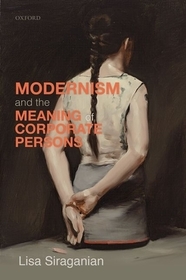
Modernism and the Meaning of Corporate Persons
Sorozatcím: Law and Literature;
-
20% KEDVEZMÉNY?
- A kedvezmény csak az 'Értesítés a kedvenc témákról' hírlevelünk címzettjeinek rendeléseire érvényes.
- Kiadói listaár GBP 102.50
-
46 278 Ft (44 075 Ft + 5% áfa)
Az ár azért becsült, mert a rendelés pillanatában nem lehet pontosan tudni, hogy a beérkezéskor milyen lesz a forint árfolyama az adott termék eredeti devizájához képest. Ha a forint romlana, kissé többet, ha javulna, kissé kevesebbet kell majd fizetnie.
- Kedvezmény(ek) 20% (cc. 9 256 Ft off)
- Kedvezményes ár 37 023 Ft (35 260 Ft + 5% áfa)
- A kedvezmény érvényes eddig: 2026. június 30.
Iratkozzon fel most és részesüljön kedvezőbb árainkból!
Feliratkozom
46 278 Ft

Beszerezhetőség
Becsült beszerzési idő: A Prosperónál jelenleg nincsen raktáron, de a kiadónál igen. Beszerzés kb. 3-5 hét..
A Prosperónál jelenleg nincsen raktáron.
Why don't you give exact delivery time?
A beszerzés időigényét az eddigi tapasztalatokra alapozva adjuk meg. Azért becsült, mert a terméket külföldről hozzuk be, így a kiadó kiszolgálásának pillanatnyi gyorsaságától is függ. A megadottnál gyorsabb és lassabb szállítás is elképzelhető, de mindent megteszünk, hogy Ön a lehető leghamarabb jusson hozzá a termékhez.
A termék adatai:
- Kiadó OUP Oxford
- Megjelenés dátuma 2020. november 19.
- ISBN 9780198868873
- Kötéstípus Keménykötés
- Terjedelem288 oldal
- Méret 240x165x24 mm
- Súly 598 g
- Nyelv angol
- Illusztrációk 19 Illustrations 55
Kategóriák
Rövid leírás:
Exploring legal treatises, court decisions, political illustrations, photographs, and modernist literature, this volume reveals that the ambiguous status of corporate intention in the first half of the twentieth century provoked conflicting theories of meaning and interpretation still debated today.
TöbbHosszú leírás:
Long before the US Supreme Court announced that corporate persons freely "speak" with money in Citizens United v. Federal Election Commission (2010), they elaborated the legal fiction of American corporate personhood in Santa Clara v. Southern Pacific Railroad (1886). Yet endowing a non-human entity with certain rights exposed a fundamental philosophical question about the possibility of collective intention. That question extended beyond the law and became essential to modern American literature. This volume offers the first multidisciplinary intellectual history of this story of corporate personhood.
The possibility that large collective organizations might mean to act like us, like persons, animated a diverse set of American writers, artists, and theorists of the corporation in the first half of the twentieth century, stimulating a revolution of thought on intention. The ambiguous status of corporate intention provoked conflicting theories of meaning--on the relevance (or not) of authorial intention and the interpretation of collective signs or social forms--still debated today. As law struggled with opposing arguments, modernist creative writers and artists grappled with interrelated questions, albeit under different guises and formal procedures. Combining legal analysis of law reviews, treatises, and case law with literary interpretation of short stories, novels, and poems, this volume analyzes legal philosophers including Oliver Wendell Holmes, Jr., Frederic Maitland, Harold Laski, Maurice Wormser, and creative writers such as Theodore Dreiser, Muriel Rukeyser, Gertrude Stein, Charles Reznikoff, F. Scott Fitzgerald, and George Schuyler.
The lessons that Modernism and the Meaning of Corporate Persons afford are both timely and timeless. The fundamental questions that Siraganian's study poses are perennial ones of legal and philosophical thought regarding corporate personhood ... Siraganian's history both finds possible avenues for wrestling with these questions that we have largely forgotten or ignored, and, in the process, tells a clear story of corporate personhood in the US. In this way, this study is likely to be a touchstone for those interested in law and literature, as well as studies of corporate personhood more broadly.
Tartalomjegyzék:
Introduction: Acting Corporate
Contracting Without Meaning
Incoherent Corporate Speech
Emergent Corporate Mind
Limited Poetic Liability
Invisible Corporate Man
Coda as Brief: Contemporary Literature v. Hobby Lobby

