

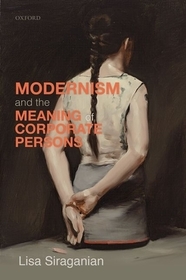
Modernism and the Meaning of Corporate Persons
Series: Law and Literature;
- Publisher's listprice GBP 102.50
-
46 278 Ft (44 075 Ft + 5% VAT)
The price is estimated because at the time of ordering we do not know what conversion rates will apply to HUF / product currency when the book arrives. In case HUF is weaker, the price increases slightly, in case HUF is stronger, the price goes lower slightly.
- Discount 20% (cc. 9 256 Ft off)
- Discounted price 37 023 Ft (35 260 Ft + 5% VAT)
- Discount is valid until: 30 June 2026
Subcribe now and take benefit of a favourable price.
Subscribe
46 278 Ft

Availability
Estimated delivery time: In stock at the publisher, but not at Prospero's office. Delivery time approx. 3-5 weeks.
Not in stock at Prospero.
Why don't you give exact delivery time?
Delivery time is estimated on our previous experiences. We give estimations only, because we order from outside Hungary, and the delivery time mainly depends on how quickly the publisher supplies the book. Faster or slower deliveries both happen, but we do our best to supply as quickly as possible.
Product details:
- Publisher OUP Oxford
- Date of Publication 19 November 2020
- ISBN 9780198868873
- Binding Hardback
- No. of pages288 pages
- Size 240x165x24 mm
- Weight 598 g
- Language English
- Illustrations 19 Illustrations 55
Categories
Short description:
Exploring legal treatises, court decisions, political illustrations, photographs, and modernist literature, this volume reveals that the ambiguous status of corporate intention in the first half of the twentieth century provoked conflicting theories of meaning and interpretation still debated today.
MoreLong description:
Long before the US Supreme Court announced that corporate persons freely "speak" with money in Citizens United v. Federal Election Commission (2010), they elaborated the legal fiction of American corporate personhood in Santa Clara v. Southern Pacific Railroad (1886). Yet endowing a non-human entity with certain rights exposed a fundamental philosophical question about the possibility of collective intention. That question extended beyond the law and became essential to modern American literature. This volume offers the first multidisciplinary intellectual history of this story of corporate personhood.
The possibility that large collective organizations might mean to act like us, like persons, animated a diverse set of American writers, artists, and theorists of the corporation in the first half of the twentieth century, stimulating a revolution of thought on intention. The ambiguous status of corporate intention provoked conflicting theories of meaning--on the relevance (or not) of authorial intention and the interpretation of collective signs or social forms--still debated today. As law struggled with opposing arguments, modernist creative writers and artists grappled with interrelated questions, albeit under different guises and formal procedures. Combining legal analysis of law reviews, treatises, and case law with literary interpretation of short stories, novels, and poems, this volume analyzes legal philosophers including Oliver Wendell Holmes, Jr., Frederic Maitland, Harold Laski, Maurice Wormser, and creative writers such as Theodore Dreiser, Muriel Rukeyser, Gertrude Stein, Charles Reznikoff, F. Scott Fitzgerald, and George Schuyler.
The lessons that Modernism and the Meaning of Corporate Persons afford are both timely and timeless. The fundamental questions that Siraganian's study poses are perennial ones of legal and philosophical thought regarding corporate personhood ... Siraganian's history both finds possible avenues for wrestling with these questions that we have largely forgotten or ignored, and, in the process, tells a clear story of corporate personhood in the US. In this way, this study is likely to be a touchstone for those interested in law and literature, as well as studies of corporate personhood more broadly.
Table of Contents:
Introduction: Acting Corporate
Contracting Without Meaning
Incoherent Corporate Speech
Emergent Corporate Mind
Limited Poetic Liability
Invisible Corporate Man
Coda as Brief: Contemporary Literature v. Hobby Lobby

