

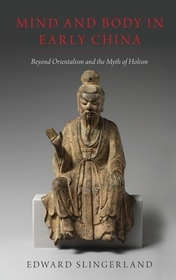
Mind and Body in Early China
Beyond Orientalism and the Myth of Holism
-
10% KEDVEZMÉNY?
- A kedvezmény csak az 'Értesítés a kedvenc témákról' hírlevelünk címzettjeinek rendeléseire érvényes.
- Kiadói listaár GBP 37.99
-
17 152 Ft (16 335 Ft + 5% áfa)
Az ár azért becsült, mert a rendelés pillanatában nem lehet pontosan tudni, hogy a beérkezéskor milyen lesz a forint árfolyama az adott termék eredeti devizájához képest. Ha a forint romlana, kissé többet, ha javulna, kissé kevesebbet kell majd fizetnie.
- Kedvezmény(ek) 10% (kb. 1 715 Ft)
- Kedvezményes ár 15 437 Ft (14 702 Ft + 5% áfa)
Iratkozzon fel most és részesüljön kedvezőbb árainkból!
Feliratkozom
17 152 Ft

Beszerezhetőség
Megrendelésre a kiadó utánnyomja a könyvet. Rendelhető, de a szokásosnál kicsit lassabban érkezik meg.
Why don't you give exact delivery time?
A beszerzés időigényét az eddigi tapasztalatokra alapozva adjuk meg. Azért becsült, mert a terméket külföldről hozzuk be, így a kiadó kiszolgálásának pillanatnyi gyorsaságától is függ. A megadottnál gyorsabb és lassabb szállítás is elképzelhető, de mindent megteszünk, hogy Ön a lehető leghamarabb jusson hozzá a termékhez.
A termék adatai:
- Kiadó OUP USA
- Megjelenés dátuma 2019. február 28.
- ISBN 9780190842307
- Kötéstípus Keménykötés
- Terjedelem400 oldal
- Méret 236x163x38 mm
- Súly 658 g
- Nyelv angol
- Illusztrációk 19 0
Kategóriák
Rövid leírás:
Mind and Body in Early China critiques Orientalist accounts of early China as a radical "holistic" other, which saw no qualitative difference between mind and body. Drawing on knowledge and techniques from the sciences and digital humanities, Edward Slingerland demonstrates that seeing a difference between mind and body is a psychological universal, and that human sociality would be fundamentally impossible without it. This book has implications for anyone interested in comparative religion, early China, cultural studies, digital humanities, or science-humanities integration.
TöbbHosszú leírás:
Mind and Body in Early China critiques Orientalist accounts of early China as the radical, "holistic" other. The idea that the early Chinese held the "strong" holist view, seeing no qualitative difference between mind and body, has long been contradicted by traditional archeological and qualitative textual evidence. New digital humanities methods, along with basic knowledge about human cognition, now make this position untenable. A large body of empirical evidence suggests that "weak" mind-body dualism is a psychological universal, and that human sociality would be fundamentally impossible without it.
Edward Slingerland argues that the humanities need to move beyond social constructivist views of culture, and embrace instead a view of human cognition and culture that integrates the sciences and the humanities. Our interpretation of texts and artifacts from the past and from other cultures should be constrained by what we know about the species-specific, embodied commonalities shared by all humans. This book also attempts to broaden the scope of humanistic methodologies by employing team-based qualitative coding and computer-aided "distant reading" of texts, while also drawing upon our current best understanding of human cognition to transform our basic starting point. It has implications for anyone interested in comparative religion, early China, cultural studies, digital humanities, or science-humanities integration.
The book should be of interest not only to those who are specialists in East Asian religions or Sinology, but to those as well who want to witness where the humanities-science dialogue usually falters and how the trenches between the two could be charitably buried at last.
Tartalomjegyzék:
Introduction
Chapter One: The Myth of Holism in Early China
PART I: Qualitative Approaches to Concepts of Mind and Body
Chapter Two: Soul and Body: Traditional Archeological and Textual Evidence for Soul-Body Dualism
Chapter Three: Mind-Body Dualism in the Textual Record
PART II: Quantitative Approaches to Concepts of Mind and Body
Chapter Four: Embracing the Digital Humanities: New Methods for Analyzing Texts and Sharing Scholarly Knowledge
PART III: Methodological Issues in the Interpretation of Textual Corpora
Chapter Five: Hermeneutical Constraints: Minds in Our Bodies and Our Feet on the Ground
Chapter Six: Hermeneutical Excesses: Interpretive Missteps and the Essentialist Trap
Conclusion: Naturalistic Hermeneutics and the End of Orientalism
Bibliography
Index

