

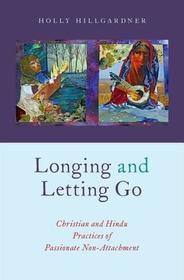
Longing and Letting Go
Christian and Hindu Practices of Passionate Non-Attachment
Sorozatcím: AAR Academy Series;
-
10% KEDVEZMÉNY?
- A kedvezmény csak az 'Értesítés a kedvenc témákról' hírlevelünk címzettjeinek rendeléseire érvényes.
- Kiadói listaár GBP 97.00
-
46 341 Ft (44 135 Ft + 5% áfa)
Az ár azért becsült, mert a rendelés pillanatában nem lehet pontosan tudni, hogy a beérkezéskor milyen lesz a forint árfolyama az adott termék eredeti devizájához képest. Ha a forint romlana, kissé többet, ha javulna, kissé kevesebbet kell majd fizetnie.
- Kedvezmény(ek) 10% (cc. 4 634 Ft off)
- Kedvezményes ár 41 708 Ft (39 722 Ft + 5% áfa)
Iratkozzon fel most és részesüljön kedvezőbb árainkból!
Feliratkozom
46 341 Ft

Beszerezhetőség
Megrendelésre a kiadó utánnyomja a könyvet. Rendelhető, de a szokásosnál kicsit lassabban érkezik meg.
Why don't you give exact delivery time?
A beszerzés időigényét az eddigi tapasztalatokra alapozva adjuk meg. Azért becsült, mert a terméket külföldről hozzuk be, így a kiadó kiszolgálásának pillanatnyi gyorsaságától is függ. A megadottnál gyorsabb és lassabb szállítás is elképzelhető, de mindent megteszünk, hogy Ön a lehető leghamarabb jusson hozzá a termékhez.
A termék adatai:
- Kiadó OUP USA
- Megjelenés dátuma 2016. december 29.
- ISBN 9780190455538
- Kötéstípus Keménykötés
- Terjedelem188 oldal
- Méret 236x157x22 mm
- Súly 408 g
- Nyelv angol 0
Kategóriák
Rövid leírás:
Can we love God and others without our desires eclipsing the very beauty, integrity and diversity toward which we are drawn; that is, can we love without trying to possess?
TöbbHosszú leírás:
Longing and Letting Go explores and compares the energies of desire and non-attachment in the writings of Hadewijch, a thirteenth-century Christian Beguine, and Mirabai, a sixteenth-century Hindu bhakta. Through an examination of the relational power of their respective mystical poetics of longing, the book invites interreligious meditation in the middle spaces of longing as a resource for an ethic of social justice: passionate non-attachment thus surfaces as an interreligious value and practice in the service of a less oppressive world.
Mirabai and Hadewijch are both read through the primary comparative framework of viraha-bhakti, a mystical eroticism from Mirabai's Vaisnava Hindu tradition that fosters communal experiences of longing. Mirabai's songs of viraha-bhakti are conversely read through the lens of Hadewijch's concept of "noble unfaith," which will be construed as a particular version of passionate non-attachment. Reading back and forth across the traditions, the comparative currents move into the thematics of apophatic theological anthropology, comparative feminist ethics, and religiously plural identities. Judith Butler provides a philosophically complementary schema through which to consider how the mystics' desire, manifest in the grief of separation and the erotic bliss of near union, operates as a force of "dispossession" that creates the very conditions for non-attachment. Hadewijch's and Mirabai's practices of longing, read in terms of Butler's concept of dispossession, offer clues for a lived ethic that encourages desire for the flourishing of the world, without that passion consuming the world, the other, or the self.
Longing--in its vulnerable, relational, apophatic, dispossessive aspects--informs a lived ethic of passionate non-attachment, which holds space for the desires of others in an interrelated, fragile world. When configured as performative relationality and applied to the discipline of comparative theology, practices of longing decenter the self and allow for the emergence of dynamic, even plural, religious identities.
Hillgardner is to be commended for a remarkable contribution to Hindu-Christian studies (not to mention comparative theology, feminist theology, and the comparative study of mysticism). The volume is quite readable--without losing any scholarly facility. It may be beyond the reach of many undergraduate students, but the book will be immensely valuable to graduate students, scholars, and anyone interested in Mirabai, Hadewijch, and/or comparative studies.
Tartalomjegyzék:
Acknowledgments
Notes on Translations and Diacritics
1. The Paradox of Longing and Letting Go
2. Mirabai's Love-Longing and Passionate Non-Attachment
3. Looking Closer: Mirabai's Voices of Longing and Letting Go
4. Hadewijch's Love-Longing and Passionate Non-Attachment
5. Looking Closer: Hadewijch's Voices of Longing and Letting Go
6. Longing Together: Comparative Practices of Passionate Non-Attachment
7. Becoming Undone: Mirabai, Hadewijch and Dispossession
8. Toward an Interreligious Ethic of Passionate Non-Attachment
Bibliography
Index

