

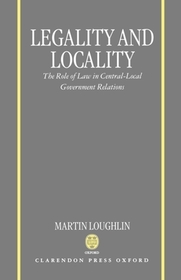
Legality and Locality
The Role of Law in Central-Local Government Relations
-
10% KEDVEZMÉNY?
- A kedvezmény csak az 'Értesítés a kedvenc témákról' hírlevelünk címzettjeinek rendeléseire érvényes.
- Kiadói listaár GBP 98.00
-
44 247 Ft (42 140 Ft + 5% áfa)
Az ár azért becsült, mert a rendelés pillanatában nem lehet pontosan tudni, hogy a beérkezéskor milyen lesz a forint árfolyama az adott termék eredeti devizájához képest. Ha a forint romlana, kissé többet, ha javulna, kissé kevesebbet kell majd fizetnie.
- Kedvezmény(ek) 10% (kb. 4 425 Ft)
- Kedvezményes ár 39 822 Ft (37 926 Ft + 5% áfa)
Iratkozzon fel most és részesüljön kedvezőbb árainkból!
Feliratkozom
44 247 Ft

Beszerezhetőség
Megrendelésre a kiadó utánnyomja a könyvet. Rendelhető, de a szokásosnál kicsit lassabban érkezik meg.
Why don't you give exact delivery time?
A beszerzés időigényét az eddigi tapasztalatokra alapozva adjuk meg. Azért becsült, mert a terméket külföldről hozzuk be, így a kiadó kiszolgálásának pillanatnyi gyorsaságától is függ. A megadottnál gyorsabb és lassabb szállítás is elképzelhető, de mindent megteszünk, hogy Ön a lehető leghamarabb jusson hozzá a termékhez.
A termék adatai:
- Kiadó OUP Oxford
- Megjelenés dátuma 1996. augusztus 22.
- ISBN 9780198260158
- Kötéstípus Keménykötés
- Terjedelem464 oldal
- Méret 242x162x30 mm
- Súly 876 g
- Nyelv angol 0
Kategóriák
Rövid leírás:
This book traces the main dimensions of the relationship between central and local government, concentrating in particular upon the role played by law in shaping that relationship. It is a neglected and important subject which has risen to prominence in the years of Conservative government since 1979. Ultimately the book seeks to demonstrate that the issues raised by an examination of central-local relations transcend the institution of local government and are directly linked to our system of parliamentary democracy, and to our tradition of public law.
TöbbHosszú leírás:
This book seeks to trace the main dimensions of recent conflicts between central departments of governments and local authorities and to reveal something of their significance. It does so by focusing on the role of law in shaping the central-local government relations which is neglected in many contemporary studies and yet is of vital importance in identifying the character of that relationship. Precisely why they should be so is not self-evident. The main objective of this introduction therefore is to highlight the importance of this dimension to the study of central-local relations and then to explain the way in which the key themes of the study are to be addressed.
One highly significant aspect of the study is the identification of a process of juridfication which is only gradually becoming clear. This has not only been a major undertaking, it has also been a highly complex, ambiguous, confusing, and frustrating activity. This has caused problems for government and for the judiciary and not surprisingly there have been expressions of discomfort on all sides. This book helps to explain where the process may have gone wrong and why ultimately it may be an objective which cannot be realised.
Ultimately what the book seeks to demonstrate is that the issues raised by the government of central-local relations transcend the institution of local government and are directly linked to our system of parliamentary democracy. Furthermore the author argues that the system of central-local government relations has evolved in such a way that it reveals a great deal about our tradition of public law. An examination of these issues through an explication of the themes of legality and locality therefore requires the reader to address basic questions about the nature of contemporary British government.
'an impressive book...What is impressive about the book is its careful analysis of both the legislation and the key cases that have marked the past 17 years...The major contribution of the volume is to show the quantitative and qualitative changes that have taken place since 1979, not merely in legislation but in the role played by the courts.'

