

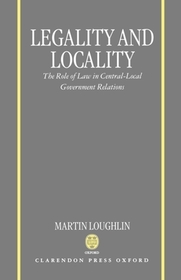
Legality and Locality
The Role of Law in Central-Local Government Relations
- Publisher's listprice GBP 98.00
-
44 247 Ft (42 140 Ft + 5% VAT)
The price is estimated because at the time of ordering we do not know what conversion rates will apply to HUF / product currency when the book arrives. In case HUF is weaker, the price increases slightly, in case HUF is stronger, the price goes lower slightly.
- Discount 10% (cc. 4 425 Ft off)
- Discounted price 39 822 Ft (37 926 Ft + 5% VAT)
Subcribe now and take benefit of a favourable price.
Subscribe
44 247 Ft

Availability
printed on demand
Why don't you give exact delivery time?
Delivery time is estimated on our previous experiences. We give estimations only, because we order from outside Hungary, and the delivery time mainly depends on how quickly the publisher supplies the book. Faster or slower deliveries both happen, but we do our best to supply as quickly as possible.
Product details:
- Publisher OUP Oxford
- Date of Publication 22 August 1996
- ISBN 9780198260158
- Binding Hardback
- No. of pages464 pages
- Size 242x162x30 mm
- Weight 876 g
- Language English 0
Categories
Short description:
This book traces the main dimensions of the relationship between central and local government, concentrating in particular upon the role played by law in shaping that relationship. It is a neglected and important subject which has risen to prominence in the years of Conservative government since 1979. Ultimately the book seeks to demonstrate that the issues raised by an examination of central-local relations transcend the institution of local government and are directly linked to our system of parliamentary democracy, and to our tradition of public law.
MoreLong description:
This book seeks to trace the main dimensions of recent conflicts between central departments of governments and local authorities and to reveal something of their significance. It does so by focusing on the role of law in shaping the central-local government relations which is neglected in many contemporary studies and yet is of vital importance in identifying the character of that relationship. Precisely why they should be so is not self-evident. The main objective of this introduction therefore is to highlight the importance of this dimension to the study of central-local relations and then to explain the way in which the key themes of the study are to be addressed.
One highly significant aspect of the study is the identification of a process of juridfication which is only gradually becoming clear. This has not only been a major undertaking, it has also been a highly complex, ambiguous, confusing, and frustrating activity. This has caused problems for government and for the judiciary and not surprisingly there have been expressions of discomfort on all sides. This book helps to explain where the process may have gone wrong and why ultimately it may be an objective which cannot be realised.
Ultimately what the book seeks to demonstrate is that the issues raised by the government of central-local relations transcend the institution of local government and are directly linked to our system of parliamentary democracy. Furthermore the author argues that the system of central-local government relations has evolved in such a way that it reveals a great deal about our tradition of public law. An examination of these issues through an explication of the themes of legality and locality therefore requires the reader to address basic questions about the nature of contemporary British government.
'an impressive book...What is impressive about the book is its careful analysis of both the legislation and the key cases that have marked the past 17 years...The major contribution of the volume is to show the quantitative and qualitative changes that have taken place since 1979, not merely in legislation but in the role played by the courts.'

