

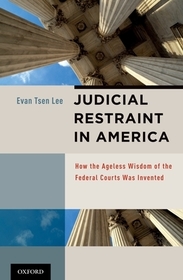
Judicial Restraint in America
How the Ageless Wisdom of the Federal Courts was Invented
-
10% KEDVEZMÉNY?
- A kedvezmény csak az 'Értesítés a kedvenc témákról' hírlevelünk címzettjeinek rendeléseire érvényes.
- Kiadói listaár GBP 92.00
-
41 538 Ft (39 560 Ft + 5% áfa)
Az ár azért becsült, mert a rendelés pillanatában nem lehet pontosan tudni, hogy a beérkezéskor milyen lesz a forint árfolyama az adott termék eredeti devizájához képest. Ha a forint romlana, kissé többet, ha javulna, kissé kevesebbet kell majd fizetnie.
- Kedvezmény(ek) 10% (cc. 4 154 Ft off)
- Kedvezményes ár 37 384 Ft (35 604 Ft + 5% áfa)
Iratkozzon fel most és részesüljön kedvezőbb árainkból!
Feliratkozom
41 538 Ft

Beszerezhetőség
Megrendelésre a kiadó utánnyomja a könyvet. Rendelhető, de a szokásosnál kicsit lassabban érkezik meg.
Why don't you give exact delivery time?
A beszerzés időigényét az eddigi tapasztalatokra alapozva adjuk meg. Azért becsült, mert a terméket külföldről hozzuk be, így a kiadó kiszolgálásának pillanatnyi gyorsaságától is függ. A megadottnál gyorsabb és lassabb szállítás is elképzelhető, de mindent megteszünk, hogy Ön a lehető leghamarabb jusson hozzá a termékhez.
A termék adatai:
- Kiadó OUP USA
- Megjelenés dátuma 2011. január 20.
- ISBN 9780195340341
- Kötéstípus Keménykötés
- Terjedelem248 oldal
- Méret 236x157x22 mm
- Súly 499 g
- Nyelv angol 0
Kategóriák
Rövid leírás:
In Judicial Restraint in America: How the Ageless Wisdom of the Federal Courts was Invented, Evan Tsen Lee traces the cultural, social, and intellectual forces that shaped the contours of judicial restraint from the time of John Marshall, through the "vested property rights" courts of the early 20th Century, through the Warren Court, and up to the present. This book aims to demonstrate that the concept of judicial restraint cannot be meaningfully viewed outside of the varying contexts of American history.
TöbbHosszú leírás:
Many legal scholars believe that judges should not be "activists." But exactly what does it mean for judges to practice "restraint," and how did that set of practices evolve in America? In Judicial Restraint in America: How the Ageless Wisdom of the Federal Courts was Invented, Evan Tsen Lee traces the cultural, social, and intellectual forces that shaped the contours of judicial restraint from the time of John Marshall, through the "vested property rights" courts of the early 20th Century, through the Warren Court, and up to the present. The Supreme Court and the many lower federal courts have long used mystifying technical doctrines known as "standing" and "abstention" out of a professed fidelity to judicial restraint. Yet this book aims to demonstrate that the concept of judicial restraint cannot be meaningfully viewed outside of the varying contexts of American history. The notion of judicial restraint only makes sense in light of the waxing and waning American commitments to property rights and Protestant idealism, to scientific pragmatism, to racial equality, and even to environmental protection and the need to stem climate change. This book focuses on the personalities and lives of powerhouse Supreme Court justices - John Marshall, Oliver Wendell Holmes, Louis Brandeis, Felix Frankfurter, William Brennan, and now Antonin Scalia. Largely written in narrative form, it will appeal to those interested in how politics, society, and the power of ideas have shaped American public law.
Lee's Incisive and carefully reasoned book traces the evolution of ideas about judicial restraint, especially the doctrine of 'standing,' from Marbury v. Madison to the present.
Tartalomjegyzék:
TABLE OF CONTENTS
Preface
Prologue
Chapter One: John Marshall and the Inseparability of Action and Restraint
Chapter Two: David Brewer, Natural Rights, and the Triumph of Equity
Chapter Three: From Protestant Idealism to Scientific Pragmatism
Chapter Four: Brandeis and Limits on Federal Judicial Power
Chapter Five: Frankfurter and the Intellectualization of Judicial Restraint
Chapter Six: Brennan, Civil Rights, and the "Personal Stake" Gambit
Chapter Seven: The Triumph of Self-Interest
Chapter Eight: Scalia, the Environment, and the Modern Standing Doctrine
Postscript: The People, the Court, and the Academics
Index

