

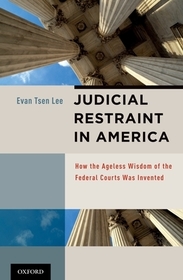
Judicial Restraint in America
How the Ageless Wisdom of the Federal Courts was Invented
- Publisher's listprice GBP 92.00
-
41 538 Ft (39 560 Ft + 5% VAT)
The price is estimated because at the time of ordering we do not know what conversion rates will apply to HUF / product currency when the book arrives. In case HUF is weaker, the price increases slightly, in case HUF is stronger, the price goes lower slightly.
- Discount 10% (cc. 4 154 Ft off)
- Discounted price 37 384 Ft (35 604 Ft + 5% VAT)
Subcribe now and take benefit of a favourable price.
Subscribe
41 538 Ft

Availability
printed on demand
Why don't you give exact delivery time?
Delivery time is estimated on our previous experiences. We give estimations only, because we order from outside Hungary, and the delivery time mainly depends on how quickly the publisher supplies the book. Faster or slower deliveries both happen, but we do our best to supply as quickly as possible.
Product details:
- Publisher OUP USA
- Date of Publication 20 January 2011
- ISBN 9780195340341
- Binding Hardback
- No. of pages248 pages
- Size 236x157x22 mm
- Weight 499 g
- Language English 0
Categories
Short description:
In Judicial Restraint in America: How the Ageless Wisdom of the Federal Courts was Invented, Evan Tsen Lee traces the cultural, social, and intellectual forces that shaped the contours of judicial restraint from the time of John Marshall, through the "vested property rights" courts of the early 20th Century, through the Warren Court, and up to the present. This book aims to demonstrate that the concept of judicial restraint cannot be meaningfully viewed outside of the varying contexts of American history.
MoreLong description:
Many legal scholars believe that judges should not be "activists." But exactly what does it mean for judges to practice "restraint," and how did that set of practices evolve in America? In Judicial Restraint in America: How the Ageless Wisdom of the Federal Courts was Invented, Evan Tsen Lee traces the cultural, social, and intellectual forces that shaped the contours of judicial restraint from the time of John Marshall, through the "vested property rights" courts of the early 20th Century, through the Warren Court, and up to the present. The Supreme Court and the many lower federal courts have long used mystifying technical doctrines known as "standing" and "abstention" out of a professed fidelity to judicial restraint. Yet this book aims to demonstrate that the concept of judicial restraint cannot be meaningfully viewed outside of the varying contexts of American history. The notion of judicial restraint only makes sense in light of the waxing and waning American commitments to property rights and Protestant idealism, to scientific pragmatism, to racial equality, and even to environmental protection and the need to stem climate change. This book focuses on the personalities and lives of powerhouse Supreme Court justices - John Marshall, Oliver Wendell Holmes, Louis Brandeis, Felix Frankfurter, William Brennan, and now Antonin Scalia. Largely written in narrative form, it will appeal to those interested in how politics, society, and the power of ideas have shaped American public law.
Lee's Incisive and carefully reasoned book traces the evolution of ideas about judicial restraint, especially the doctrine of 'standing,' from Marbury v. Madison to the present.
Table of Contents:
TABLE OF CONTENTS
Preface
Prologue
Chapter One: John Marshall and the Inseparability of Action and Restraint
Chapter Two: David Brewer, Natural Rights, and the Triumph of Equity
Chapter Three: From Protestant Idealism to Scientific Pragmatism
Chapter Four: Brandeis and Limits on Federal Judicial Power
Chapter Five: Frankfurter and the Intellectualization of Judicial Restraint
Chapter Six: Brennan, Civil Rights, and the "Personal Stake" Gambit
Chapter Seven: The Triumph of Self-Interest
Chapter Eight: Scalia, the Environment, and the Modern Standing Doctrine
Postscript: The People, the Court, and the Academics
Index

