

-
10% KEDVEZMÉNY?
- A kedvezmény csak az 'Értesítés a kedvenc témákról' hírlevelünk címzettjeinek rendeléseire érvényes.
- Kiadói listaár GBP 107.50
-
48 536 Ft (46 225 Ft + 5% áfa)
Az ár azért becsült, mert a rendelés pillanatában nem lehet pontosan tudni, hogy a beérkezéskor milyen lesz a forint árfolyama az adott termék eredeti devizájához képest. Ha a forint romlana, kissé többet, ha javulna, kissé kevesebbet kell majd fizetnie.
- Kedvezmény(ek) 10% (cc. 4 854 Ft off)
- Kedvezményes ár 43 683 Ft (41 603 Ft + 5% áfa)
Iratkozzon fel most és részesüljön kedvezőbb árainkból!
Feliratkozom
48 536 Ft

Beszerezhetőség
Megrendelésre a kiadó utánnyomja a könyvet. Rendelhető, de a szokásosnál kicsit lassabban érkezik meg.
Why don't you give exact delivery time?
A beszerzés időigényét az eddigi tapasztalatokra alapozva adjuk meg. Azért becsült, mert a terméket külföldről hozzuk be, így a kiadó kiszolgálásának pillanatnyi gyorsaságától is függ. A megadottnál gyorsabb és lassabb szállítás is elképzelhető, de mindent megteszünk, hogy Ön a lehető leghamarabb jusson hozzá a termékhez.
A termék adatai:
- Kiadó OUP USA
- Megjelenés dátuma 2012. március 1.
- ISBN 9780199744275
- Kötéstípus Keménykötés
- Terjedelem348 oldal
- Méret 165x234x33 mm
- Súly 578 g
- Nyelv angol 0
Kategóriák
Rövid leírás:
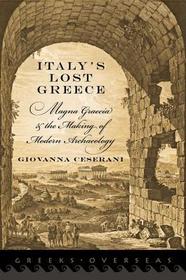
Italy's Lost Greece reveals the untold story of the modern engagement with Magna Graecia, the region of ancient Greek settlement in South Italy, and provides a unique perspective on the humanist investment in the ancient past, the evolution of modern Hellenism, and the making of the discipline of classical archaeology.
TöbbHosszú leírás:
Italy's Lost Greece is the untold story of the modern engagement with the ancient Greek settlements of South Italy--an area known since antiquity as Magna Graecia. This "Greater Greece," at once Greek and Italian, has continuously been perceived as a region in decline since its archaic golden age, and has long been relegated to the margins of classical studies. Giovanna Ceserani's evocative and nuanced analysis recovers its significance within the history of classical archaeology. It was here that the Renaissance first encountered an ancient Greek landscape, and during the "Hellenic turn" of eighteenth-century Europe the temples of Paestum and the painted vases of South Italy played major roles, but since then, Magna Graecia--lying outside the national boundaries of modern Greece, and sharing in the complicated regional dynamic of the Italian Mezzogiorno--has fitted awkwardly into the commonly accepted paradigms of Hellenism. The unfolding of this process provides a unique insight into three developments: the humanist investment in the ancient past, the evolution of modern Hellenism, and the making of classical archaeology. Drawing on antiquarian and archaeological writings, histories and travelogues about Magna Graecia, and recent rewritings of the history and imagining of the South, Italy's Lost Greece sheds new light on well known figures in the history of archaeology while recovering forgotten ones. This is an Italian story of European resonance, which transforms our understanding of the transition from antiquarianism to archaeology, of the relationship between nation-making and institution-building in the study of the ancient past, and of the reconstruction of classical Greece in the modern world.
Compelling ... Ceseraniâs volume breaks new ground in its breadth of focus.
Tartalomjegyzék:
Introduction
Discoveries and Rediscoveries
Between Classical and Marginal
Individuals and Institutions
Of Nations and Scholars
Culture and Excavation
Bibliography
Index

