

- Publisher's listprice GBP 107.50
-
48 536 Ft (46 225 Ft + 5% VAT)
The price is estimated because at the time of ordering we do not know what conversion rates will apply to HUF / product currency when the book arrives. In case HUF is weaker, the price increases slightly, in case HUF is stronger, the price goes lower slightly.
- Discount 10% (cc. 4 854 Ft off)
- Discounted price 43 683 Ft (41 603 Ft + 5% VAT)
Subcribe now and take benefit of a favourable price.
Subscribe
48 536 Ft

Availability
printed on demand
Why don't you give exact delivery time?
Delivery time is estimated on our previous experiences. We give estimations only, because we order from outside Hungary, and the delivery time mainly depends on how quickly the publisher supplies the book. Faster or slower deliveries both happen, but we do our best to supply as quickly as possible.
Product details:
- Publisher OUP USA
- Date of Publication 1 March 2012
- ISBN 9780199744275
- Binding Hardback
- No. of pages348 pages
- Size 165x234x33 mm
- Weight 578 g
- Language English 0
Categories
Short description:
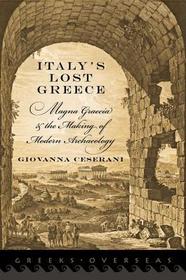
Italy's Lost Greece reveals the untold story of the modern engagement with Magna Graecia, the region of ancient Greek settlement in South Italy, and provides a unique perspective on the humanist investment in the ancient past, the evolution of modern Hellenism, and the making of the discipline of classical archaeology.
MoreLong description:
Italy's Lost Greece is the untold story of the modern engagement with the ancient Greek settlements of South Italy--an area known since antiquity as Magna Graecia. This "Greater Greece," at once Greek and Italian, has continuously been perceived as a region in decline since its archaic golden age, and has long been relegated to the margins of classical studies. Giovanna Ceserani's evocative and nuanced analysis recovers its significance within the history of classical archaeology. It was here that the Renaissance first encountered an ancient Greek landscape, and during the "Hellenic turn" of eighteenth-century Europe the temples of Paestum and the painted vases of South Italy played major roles, but since then, Magna Graecia--lying outside the national boundaries of modern Greece, and sharing in the complicated regional dynamic of the Italian Mezzogiorno--has fitted awkwardly into the commonly accepted paradigms of Hellenism. The unfolding of this process provides a unique insight into three developments: the humanist investment in the ancient past, the evolution of modern Hellenism, and the making of classical archaeology. Drawing on antiquarian and archaeological writings, histories and travelogues about Magna Graecia, and recent rewritings of the history and imagining of the South, Italy's Lost Greece sheds new light on well known figures in the history of archaeology while recovering forgotten ones. This is an Italian story of European resonance, which transforms our understanding of the transition from antiquarianism to archaeology, of the relationship between nation-making and institution-building in the study of the ancient past, and of the reconstruction of classical Greece in the modern world.
Compelling ... Ceseraniâs volume breaks new ground in its breadth of focus.
Table of Contents:
Introduction
Discoveries and Rediscoveries
Between Classical and Marginal
Individuals and Institutions
Of Nations and Scholars
Culture and Excavation
Bibliography
Index

