

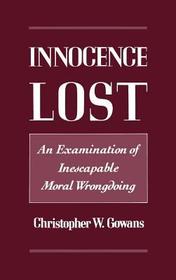
Innocence Lost
An Examination of Inescapable Moral Wrongdoing
-
10% KEDVEZMÉNY?
- A kedvezmény csak az 'Értesítés a kedvenc témákról' hírlevelünk címzettjeinek rendeléseire érvényes.
- Kiadói listaár GBP 45.99
-
21 971 Ft (20 925 Ft + 5% áfa)
Az ár azért becsült, mert a rendelés pillanatában nem lehet pontosan tudni, hogy a beérkezéskor milyen lesz a forint árfolyama az adott termék eredeti devizájához képest. Ha a forint romlana, kissé többet, ha javulna, kissé kevesebbet kell majd fizetnie.
- Kedvezmény(ek) 10% (cc. 2 197 Ft off)
- Kedvezményes ár 19 774 Ft (18 833 Ft + 5% áfa)
Iratkozzon fel most és részesüljön kedvezőbb árainkból!
Feliratkozom
21 971 Ft

Beszerezhetőség
Megrendelésre a kiadó utánnyomja a könyvet. Rendelhető, de a szokásosnál kicsit lassabban érkezik meg.
Why don't you give exact delivery time?
A beszerzés időigényét az eddigi tapasztalatokra alapozva adjuk meg. Azért becsült, mert a terméket külföldről hozzuk be, így a kiadó kiszolgálásának pillanatnyi gyorsaságától is függ. A megadottnál gyorsabb és lassabb szállítás is elképzelhető, de mindent megteszünk, hogy Ön a lehető leghamarabb jusson hozzá a termékhez.
A termék adatai:
- Kiadó OUP USA
- Megjelenés dátuma 1994. augusztus 25.
- ISBN 9780195085174
- Kötéstípus Keménykötés
- Terjedelem272 oldal
- Méret 242x164x23 mm
- Súly 567 g
- Nyelv angol 0
Kategóriák
Rövid leírás:
Our lives are such that moral wrongdoing is sometimes inescapable for us. For we have moral responsibilites to persons which may conflict and which are wrong to violate even when they do conflict. Christopher Gowans argues that we must accept this conclusion if we are to make sense of our moral experience and the way in which persons are valuable to us. In defending this position, he examines the recent moral dilemmas debate, and criticizes utilitarian and Kantian approaches. He also discusses Melville's Billy Budd, methodology in moral philosophy, moral pluralism, moral tragedy, and "dirty hands" in politics.
TöbbHosszú leírás:
Our lives are such that moral wrongdoing is sometimes inescapable for us. We have moral responsibilities to persons which may conflict and which it is wrong to violate even when they do conflict. Christopher W. Gowans argues that we must accept this conclusion if we are to make sense of our moral experience and the way in which persons are valuable to us.
In defending this position, he critically examines the recent moral dilemmas debate. He maintains that what is important in this debate is not whether there are irresolvable moral conflicts, but whether there are moral conflicts in which wrongdoing is unavoidable. Though it would be incoherent to conclude moral deliberation by deciding to perform incompatible actions, he argues that there is nothing incoherent in supposing that we have conflicting moral responsibilities. In this way, he shows that it is possible to capture the intuitions of those who have defended the idea of moral dilemmas while meeting the objections of those who have rejected this idea.
Gowans carefully evaluates utilitarian and Kantian analyses of moral dilemmas. He argues that these approaches eliminate genuine moral conflict only by displacing persons as direct objects of moral concern. As an alternative, he develops a more concrete account in which moral responsibilities to persons are central. The book also includes discussions of Melville's Billy Budd, methodology in moral philosophy, moral pluralism, moral tragedy, and `dirty hands' in politics.
What is lovely about the book is the way in which his thesis is carefully nestled inside a series of complex but lucid arguments that touch on a remarkably wide array of issues....In addition to its clarity and imagination, this is also a strikingly economical book.

