

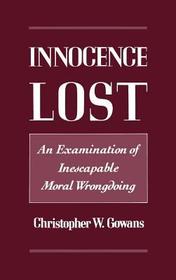
Innocence Lost
An Examination of Inescapable Moral Wrongdoing
- Publisher's listprice GBP 45.99
-
21 971 Ft (20 925 Ft + 5% VAT)
The price is estimated because at the time of ordering we do not know what conversion rates will apply to HUF / product currency when the book arrives. In case HUF is weaker, the price increases slightly, in case HUF is stronger, the price goes lower slightly.
- Discount 10% (cc. 2 197 Ft off)
- Discounted price 19 774 Ft (18 833 Ft + 5% VAT)
Subcribe now and take benefit of a favourable price.
Subscribe
21 971 Ft

Availability
printed on demand
Why don't you give exact delivery time?
Delivery time is estimated on our previous experiences. We give estimations only, because we order from outside Hungary, and the delivery time mainly depends on how quickly the publisher supplies the book. Faster or slower deliveries both happen, but we do our best to supply as quickly as possible.
Product details:
- Publisher OUP USA
- Date of Publication 25 August 1994
- ISBN 9780195085174
- Binding Hardback
- No. of pages272 pages
- Size 242x164x23 mm
- Weight 567 g
- Language English 0
Categories
Short description:
Our lives are such that moral wrongdoing is sometimes inescapable for us. For we have moral responsibilites to persons which may conflict and which are wrong to violate even when they do conflict. Christopher Gowans argues that we must accept this conclusion if we are to make sense of our moral experience and the way in which persons are valuable to us. In defending this position, he examines the recent moral dilemmas debate, and criticizes utilitarian and Kantian approaches. He also discusses Melville's Billy Budd, methodology in moral philosophy, moral pluralism, moral tragedy, and "dirty hands" in politics.
MoreLong description:
Our lives are such that moral wrongdoing is sometimes inescapable for us. We have moral responsibilities to persons which may conflict and which it is wrong to violate even when they do conflict. Christopher W. Gowans argues that we must accept this conclusion if we are to make sense of our moral experience and the way in which persons are valuable to us.
In defending this position, he critically examines the recent moral dilemmas debate. He maintains that what is important in this debate is not whether there are irresolvable moral conflicts, but whether there are moral conflicts in which wrongdoing is unavoidable. Though it would be incoherent to conclude moral deliberation by deciding to perform incompatible actions, he argues that there is nothing incoherent in supposing that we have conflicting moral responsibilities. In this way, he shows that it is possible to capture the intuitions of those who have defended the idea of moral dilemmas while meeting the objections of those who have rejected this idea.
Gowans carefully evaluates utilitarian and Kantian analyses of moral dilemmas. He argues that these approaches eliminate genuine moral conflict only by displacing persons as direct objects of moral concern. As an alternative, he develops a more concrete account in which moral responsibilities to persons are central. The book also includes discussions of Melville's Billy Budd, methodology in moral philosophy, moral pluralism, moral tragedy, and `dirty hands' in politics.
What is lovely about the book is the way in which his thesis is carefully nestled inside a series of complex but lucid arguments that touch on a remarkably wide array of issues....In addition to its clarity and imagination, this is also a strikingly economical book.

