

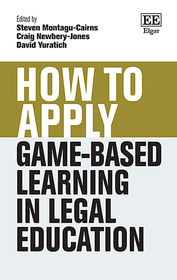
How To Apply Game-Based Learning in Legal Education
Sorozatcím: How To Guides;
-
20% KEDVEZMÉNY?
- A kedvezmény csak az 'Értesítés a kedvenc témákról' hírlevelünk címzettjeinek rendeléseire érvényes.
- Kiadói listaár GBP 85.00
-
38 377 Ft (36 550 Ft + 5% áfa)
Az ár azért becsült, mert a rendelés pillanatában nem lehet pontosan tudni, hogy a beérkezéskor milyen lesz a forint árfolyama az adott termék eredeti devizájához képest. Ha a forint romlana, kissé többet, ha javulna, kissé kevesebbet kell majd fizetnie.
- Kedvezmény(ek) 20% (cc. 7 675 Ft off)
- Kedvezményes ár 30 702 Ft (29 240 Ft + 5% áfa)
- A kedvezmény érvényes eddig: 2026. június 30.
Iratkozzon fel most és részesüljön kedvezőbb árainkból!
Feliratkozom
38 377 Ft

Beszerezhetőség
Még nem jelent meg, de rendelhető. A megjelenéstől számított néhány héten belül megérkezik.
Why don't you give exact delivery time?
A beszerzés időigényét az eddigi tapasztalatokra alapozva adjuk meg. Azért becsült, mert a terméket külföldről hozzuk be, így a kiadó kiszolgálásának pillanatnyi gyorsaságától is függ. A megadottnál gyorsabb és lassabb szállítás is elképzelhető, de mindent megteszünk, hogy Ön a lehető leghamarabb jusson hozzá a termékhez.
A termék adatai:
- Kiadó Edward Elgar Publishing
- Megjelenés dátuma 2026. február 10.
- ISBN 9781035349630
- Kötéstípus Keménykötés
- Terjedelem168 oldal
- Méret 234x156 mm
- Súly 388 g
- Nyelv angol 670
Kategóriák
Hosszú leírás:
This innovative How to Guide brings together pioneering educators to explore the integration of gaming into the law classroom, focusing on actionable insights and best practices using both academically designed and commercially available games. The book grounds itself in the context of legal education?s transformative shift towards embracing new approaches that challenge traditional pedagogical norms.
Expert contributors demonstrate how playful methodologies can facilitate profound learning experiences through diverse case studies, including using games such as Monopoly to teach financial law, LEGO? to illustrate contract principles and Minecraft to educate on sustainability. They showcase how game-based learning such as role-playing, simulations, and digital platforms enhances student engagement, deepens understanding, fosters critical thinking, and develops skills crucial for legal practice. Chapters further present step-by-step guidance for incorporating these practices, with proven techniques to increase student participation and motivation, emphasising active, experiential learning methods.
How to Apply Game-Based Learning in Legal Education is essential reading for legal educators and law faculty interested in improving their teaching methods, as well as instructional designers and game developers for its technology-driven educational resources. Legal education researchers and academics will also benefit from its analysis of emerging trends and methodologies.
This innovative How to Guide brings together pioneering educators to explore the integration of gaming into the law classroom, focusing on actionable insights and best practices using both academically designed and commercially available games. The book grounds itself in the context of legal education?s transformative shift towards embracing new approaches that challenge traditional pedagogical norms.
Tartalomjegyzék:
Contents
List of contributors vii
Prologue: the law teacher?s duty to play ix
Introduction to ?How to apply game-based learning in legal
education? 1
Steven Montagu-Cairns
1 Judge: using a card game to teach about legal reasoning 4
Thomas Giddens and David Yuratich
2 School tasking: all the information is in this chapter 13
Alison Struthers
3 Clues to success: using detective game principles to crack the
code of law assessments 21
Rebekah Marangon
4 Using traditional games to teach first year law students 29
Kate Fernandez
5 Using MONOPOLYTM to teach the legal aspects of money,
crypto and central bank digital currencies 36
Zi Yang
6 Revising Contract Law brick by brick with LEGO? 43
Marton Ribary and Antony Starza-Allen
7 War: what is it good for? Combining Warhammer with legal
education 51
Richard Ridyard
8 Simulating real-world policing challenges: the role of
immersive suites and game-based learning in the classroom 65
Richard Hind
9 Ace Attorneys: the use of visual novels in legal education 75
Joshua Warburton
10 Open justice and legal tech 81
Francine Ryan and David Byrne
11 Exploring the intersection of law and technology through the
prism of video games 89
Liam Sunner
12 Law escape rooms online 96
Samantha Woods-Peel
13 Practise for legal practice: immersive learning and simulation
using high stakes drama 102
Louisa Ashley, Kate Astall and Amy Richards
14 Virtual reality crime scene investigation: using asymmetric
virtual reality to understand digital evidence 113
Oliver Fitton
15 Bringing digital evidence and forensics to life 120
Emma Jones
16 Going solo: reflections on individually designing a single
player game for distance learning 126
Fred Motson
17 MindtheCraft Co: the corporate sustainability videogame 134
Dr Rafael Savva
18 Concluding remarks 144

