

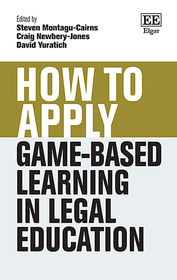
How To Apply Game-Based Learning in Legal Education
Series: How To Guides;
- Publisher's listprice GBP 85.00
-
38 377 Ft (36 550 Ft + 5% VAT)
The price is estimated because at the time of ordering we do not know what conversion rates will apply to HUF / product currency when the book arrives. In case HUF is weaker, the price increases slightly, in case HUF is stronger, the price goes lower slightly.
- Discount 20% (cc. 7 675 Ft off)
- Discounted price 30 702 Ft (29 240 Ft + 5% VAT)
- Discount is valid until: 30 June 2026
Subcribe now and take benefit of a favourable price.
Subscribe
38 377 Ft

Availability
Not yet published.
Why don't you give exact delivery time?
Delivery time is estimated on our previous experiences. We give estimations only, because we order from outside Hungary, and the delivery time mainly depends on how quickly the publisher supplies the book. Faster or slower deliveries both happen, but we do our best to supply as quickly as possible.
Product details:
- Publisher Edward Elgar Publishing
- Date of Publication 10 February 2026
- ISBN 9781035349630
- Binding Hardback
- No. of pages168 pages
- Size 234x156 mm
- Weight 388 g
- Language English 670
Categories
Long description:
This innovative How to Guide brings together pioneering educators to explore the integration of gaming into the law classroom, focusing on actionable insights and best practices using both academically designed and commercially available games. The book grounds itself in the context of legal education?s transformative shift towards embracing new approaches that challenge traditional pedagogical norms.
Expert contributors demonstrate how playful methodologies can facilitate profound learning experiences through diverse case studies, including using games such as Monopoly to teach financial law, LEGO? to illustrate contract principles and Minecraft to educate on sustainability. They showcase how game-based learning such as role-playing, simulations, and digital platforms enhances student engagement, deepens understanding, fosters critical thinking, and develops skills crucial for legal practice. Chapters further present step-by-step guidance for incorporating these practices, with proven techniques to increase student participation and motivation, emphasising active, experiential learning methods.
How to Apply Game-Based Learning in Legal Education is essential reading for legal educators and law faculty interested in improving their teaching methods, as well as instructional designers and game developers for its technology-driven educational resources. Legal education researchers and academics will also benefit from its analysis of emerging trends and methodologies.
This innovative How to Guide brings together pioneering educators to explore the integration of gaming into the law classroom, focusing on actionable insights and best practices using both academically designed and commercially available games. The book grounds itself in the context of legal education?s transformative shift towards embracing new approaches that challenge traditional pedagogical norms.
Table of Contents:
Contents
List of contributors vii
Prologue: the law teacher?s duty to play ix
Introduction to ?How to apply game-based learning in legal
education? 1
Steven Montagu-Cairns
1 Judge: using a card game to teach about legal reasoning 4
Thomas Giddens and David Yuratich
2 School tasking: all the information is in this chapter 13
Alison Struthers
3 Clues to success: using detective game principles to crack the
code of law assessments 21
Rebekah Marangon
4 Using traditional games to teach first year law students 29
Kate Fernandez
5 Using MONOPOLYTM to teach the legal aspects of money,
crypto and central bank digital currencies 36
Zi Yang
6 Revising Contract Law brick by brick with LEGO? 43
Marton Ribary and Antony Starza-Allen
7 War: what is it good for? Combining Warhammer with legal
education 51
Richard Ridyard
8 Simulating real-world policing challenges: the role of
immersive suites and game-based learning in the classroom 65
Richard Hind
9 Ace Attorneys: the use of visual novels in legal education 75
Joshua Warburton
10 Open justice and legal tech 81
Francine Ryan and David Byrne
11 Exploring the intersection of law and technology through the
prism of video games 89
Liam Sunner
12 Law escape rooms online 96
Samantha Woods-Peel
13 Practise for legal practice: immersive learning and simulation
using high stakes drama 102
Louisa Ashley, Kate Astall and Amy Richards
14 Virtual reality crime scene investigation: using asymmetric
virtual reality to understand digital evidence 113
Oliver Fitton
15 Bringing digital evidence and forensics to life 120
Emma Jones
16 Going solo: reflections on individually designing a single
player game for distance learning 126
Fred Motson
17 MindtheCraft Co: the corporate sustainability videogame 134
Dr Rafael Savva
18 Concluding remarks 144

