

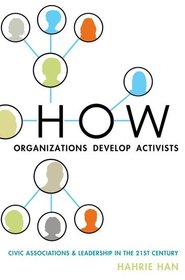
How Organizations Develop Activists
Civic Associations and Leadership in the 21st Century
-
10% KEDVEZMÉNY?
- A kedvezmény csak az 'Értesítés a kedvenc témákról' hírlevelünk címzettjeinek rendeléseire érvényes.
- Kiadói listaár GBP 147.50
-
66 596 Ft (63 425 Ft + 5% áfa)
Az ár azért becsült, mert a rendelés pillanatában nem lehet pontosan tudni, hogy a beérkezéskor milyen lesz a forint árfolyama az adott termék eredeti devizájához képest. Ha a forint romlana, kissé többet, ha javulna, kissé kevesebbet kell majd fizetnie.
- Kedvezmény(ek) 10% (cc. 6 660 Ft off)
- Kedvezményes ár 59 937 Ft (57 083 Ft + 5% áfa)
Iratkozzon fel most és részesüljön kedvezőbb árainkból!
Feliratkozom
66 596 Ft

Beszerezhetőség
Megrendelésre a kiadó utánnyomja a könyvet. Rendelhető, de a szokásosnál kicsit lassabban érkezik meg.
Why don't you give exact delivery time?
A beszerzés időigényét az eddigi tapasztalatokra alapozva adjuk meg. Azért becsült, mert a terméket külföldről hozzuk be, így a kiadó kiszolgálásának pillanatnyi gyorsaságától is függ. A megadottnál gyorsabb és lassabb szállítás is elképzelhető, de mindent megteszünk, hogy Ön a lehető leghamarabb jusson hozzá a termékhez.
A termék adatai:
- Kiadó OUP USA
- Megjelenés dátuma 2014. augusztus 21.
- ISBN 9780199336760
- Kötéstípus Keménykötés
- Terjedelem250 oldal
- Méret 160x239x17 mm
- Súly 499 g
- Nyelv angol 0
Kategóriák
Rövid leírás:
Why are some civic associations better than others at getting-and keeping-people involved in activism? Using in-person observations, surveys, and field experiments, this book compares and describes contemporary models for engaging activists to show the effectiveness of one that combine political activism with transformative personal and collective growth.
TöbbHosszú leírás:
Why are some civic associations better than others at getting--and keeping--people involved in activism? From MoveOn.org to the National Rifle Association, Health Care for America Now to the Sierra Club, membership-based civic associations constantly seek to engage people in civic and political action. What makes some more effective than others?
Using in-person observations, surveys, and field experiments, this book compares organizations with strong records of engaging people in health and environmental politics to those with weaker records. To build power, civic associations need quality and quantity (or depth and breadth) of activism. They need lots of people to take action and also a cadre of leaders to develop and execute that activity. Yet, models for how to develop activists and leaders are not necessarily transparent. This book provides these models to help associations build the power they want and support a healthy democracy. In particular, the book examines organizing, mobilizing, and lone wolf models of engagement and shows how highly active associations blend mobilizing and organizing to transform their members' motivations and capacities for involvement.
This is not a simple story about the power of offline versus online organizing. Instead, it is a story about how associations can blend both online and offline strategies to build their activist base. In this compelling book, Hahrie Han explains how civic associations can invest in their members and build the capacity they need to inspire action.
For all the scholarship on social movements and civic associations, surprisingly little research has focused on the issue of organizational effectiveness. Han's book should go a long way toward filling this gap. Using a mix of comparative case analysis and field experiments, the author offers an empirically rich, analytically compelling account of why some associations succeed in mobilizing effective collective action, while so many others fail- often spectacularly - to do so. This book deserves the widest possible audience in political science, sociology and, most importantly, among those who aspire to successful grass roots activism.
Tartalomjegyzék:
List of Tables and Figures
Acknowledgements
Chapter 1 Introduction
Chapter 2 Setting Up the Comparative Case Studies
Chapter 3 Choosing Strategies for Building Power
Chapter 4 Prospecting for Activists
Chapter 5 Developing Leaders
Chapter 6 Conclusion
Appendix A: Methods
Works Cited
Notes
Index

