

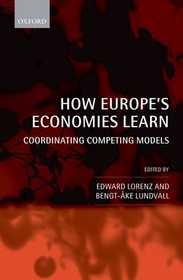
How Europe's Economies Learn
Coordinating Competing Models
-
10% KEDVEZMÉNY?
- A kedvezmény csak az 'Értesítés a kedvenc témákról' hírlevelünk címzettjeinek rendeléseire érvényes.
- Kiadói listaár GBP 49.99
-
23 882 Ft (22 745 Ft + 5% áfa)
Az ár azért becsült, mert a rendelés pillanatában nem lehet pontosan tudni, hogy a beérkezéskor milyen lesz a forint árfolyama az adott termék eredeti devizájához képest. Ha a forint romlana, kissé többet, ha javulna, kissé kevesebbet kell majd fizetnie.
- Kedvezmény(ek) 10% (cc. 2 388 Ft off)
- Kedvezményes ár 21 494 Ft (20 471 Ft + 5% áfa)
Iratkozzon fel most és részesüljön kedvezőbb árainkból!
Feliratkozom
23 882 Ft

Beszerezhetőség
Megrendelésre a kiadó utánnyomja a könyvet. Rendelhető, de a szokásosnál kicsit lassabban érkezik meg.
Why don't you give exact delivery time?
A beszerzés időigényét az eddigi tapasztalatokra alapozva adjuk meg. Azért becsült, mert a terméket külföldről hozzuk be, így a kiadó kiszolgálásának pillanatnyi gyorsaságától is függ. A megadottnál gyorsabb és lassabb szállítás is elképzelhető, de mindent megteszünk, hogy Ön a lehető leghamarabb jusson hozzá a termékhez.
A termék adatai:
- Kiadó OUP Oxford
- Megjelenés dátuma 2006. december 7.
- ISBN 9780199203192
- Kötéstípus Keménykötés
- Terjedelem480 oldal
- Méret 240x162x32 mm
- Súly 859 g
- Nyelv angol
- Illusztrációk numerous tables and line drawings 0
Kategóriák
Rövid leírás:
Develops an original and policy-relevant framework for analysing the way differences in institutional contexts, such as work organisation, labour markets, education and training systems, financial systems, and systems of social protection, shape learning processes and innovation performance across the member nations of the European Union.
TöbbHosszú leírás:
When seeking to bench mark the performance of European economies, commentators often look to compare them to the economies of Japan and the United States.
How Europe's Economies Learn shows how this is seriously misleading, and how any such comparison needs to be complemented with an understanding of the fundamental differences between Europe's economies.
The contributors provide an up-to-date description and analysis of the way differences in state systems and institutional contexts, such as labour markets, education and training systems, and financial systems, shape learning processes and innovation performance across the member nations of the European Union. In doing so, it draws important conclusion for how policy strategies should be designed at the national and European levels in order to further promote the goals of the Lisbon process.
This book is the most elaborated attempt to bridge three crucial theoretical and policy-oriented agendas: innovation, labour market and human resources. These are the very key sources for a successful European economic performance. The European Council - the most authoritative institution of the Old Continent - has clearly recognized it since its Summit in Lisbon. But what conditions should be met to transform Europe into the most dynamic knowledge economy of the world? The essays in this volume show what transformations are required to benefit from current technological opportunities. The contributors indicate that Europe can pioneer a new way of managing innovation and human resources in the world learning society.
Tartalomjegyzék:
Understanding European systems of competence building
Part I Diversity in European Systems of Competence Building
Do national systems converge?
Do national borders matter for knowledge flows and innovation diffusion?
Differences in learning and inequality
Part II Organization, Labour Markets and Corporate Governance
Learning organizations and national systems of competence building
Organizational forms and innovative performance: a comparison of the EU-15
Learning organizations and industrial relations: How the Danish economy learns
Organizational structure and the diffusion of new forms of corporate governance in Europe
Part III Education Systems and Science-industry Links
Science-technology-industry links and the 'European Paradox'
European universities under the pressure of globalization
European education systems and their contribution to the learning economy
Science-industry links and the labour markets for PhDs
Competence certification and the reform of vocational education: a comparison of the UK, France and Germany
Part IV Multi-level Governance and Policy Options
Innovation systems and institutional regimes in Europe: The impact of multi-tiered governance on national and sectoral levels of organization
National strategies of transition to a knowledge economy in the European Union- learning, innovation and the open method of coordination
Welfare systems and national systems of innovation

