

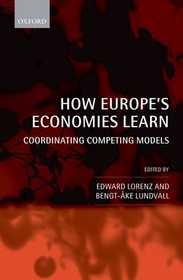
How Europe's Economies Learn
Coordinating Competing Models
- Publisher's listprice GBP 49.99
-
23 882 Ft (22 745 Ft + 5% VAT)
The price is estimated because at the time of ordering we do not know what conversion rates will apply to HUF / product currency when the book arrives. In case HUF is weaker, the price increases slightly, in case HUF is stronger, the price goes lower slightly.
- Discount 10% (cc. 2 388 Ft off)
- Discounted price 21 494 Ft (20 471 Ft + 5% VAT)
Subcribe now and take benefit of a favourable price.
Subscribe
23 882 Ft

Availability
printed on demand
Why don't you give exact delivery time?
Delivery time is estimated on our previous experiences. We give estimations only, because we order from outside Hungary, and the delivery time mainly depends on how quickly the publisher supplies the book. Faster or slower deliveries both happen, but we do our best to supply as quickly as possible.
Product details:
- Publisher OUP Oxford
- Date of Publication 7 December 2006
- ISBN 9780199203192
- Binding Hardback
- No. of pages480 pages
- Size 240x162x32 mm
- Weight 859 g
- Language English
- Illustrations numerous tables and line drawings 0
Categories
Short description:
Develops an original and policy-relevant framework for analysing the way differences in institutional contexts, such as work organisation, labour markets, education and training systems, financial systems, and systems of social protection, shape learning processes and innovation performance across the member nations of the European Union.
MoreLong description:
When seeking to bench mark the performance of European economies, commentators often look to compare them to the economies of Japan and the United States.
How Europe's Economies Learn shows how this is seriously misleading, and how any such comparison needs to be complemented with an understanding of the fundamental differences between Europe's economies.
The contributors provide an up-to-date description and analysis of the way differences in state systems and institutional contexts, such as labour markets, education and training systems, and financial systems, shape learning processes and innovation performance across the member nations of the European Union. In doing so, it draws important conclusion for how policy strategies should be designed at the national and European levels in order to further promote the goals of the Lisbon process.
This book is the most elaborated attempt to bridge three crucial theoretical and policy-oriented agendas: innovation, labour market and human resources. These are the very key sources for a successful European economic performance. The European Council - the most authoritative institution of the Old Continent - has clearly recognized it since its Summit in Lisbon. But what conditions should be met to transform Europe into the most dynamic knowledge economy of the world? The essays in this volume show what transformations are required to benefit from current technological opportunities. The contributors indicate that Europe can pioneer a new way of managing innovation and human resources in the world learning society.
Table of Contents:
Understanding European systems of competence building
Part I Diversity in European Systems of Competence Building
Do national systems converge?
Do national borders matter for knowledge flows and innovation diffusion?
Differences in learning and inequality
Part II Organization, Labour Markets and Corporate Governance
Learning organizations and national systems of competence building
Organizational forms and innovative performance: a comparison of the EU-15
Learning organizations and industrial relations: How the Danish economy learns
Organizational structure and the diffusion of new forms of corporate governance in Europe
Part III Education Systems and Science-industry Links
Science-technology-industry links and the 'European Paradox'
European universities under the pressure of globalization
European education systems and their contribution to the learning economy
Science-industry links and the labour markets for PhDs
Competence certification and the reform of vocational education: a comparison of the UK, France and Germany
Part IV Multi-level Governance and Policy Options
Innovation systems and institutional regimes in Europe: The impact of multi-tiered governance on national and sectoral levels of organization
National strategies of transition to a knowledge economy in the European Union- learning, innovation and the open method of coordination
Welfare systems and national systems of innovation

