

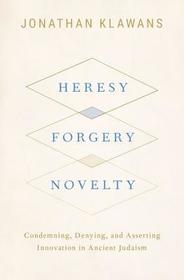
Heresy, Forgery, Novelty
Condemning, Denying, and Asserting Innovation in Ancient Judaism
-
20% KEDVEZMÉNY?
- A kedvezmény csak az 'Értesítés a kedvenc témákról' hírlevelünk címzettjeinek rendeléseire érvényes.
- Kiadói listaár GBP 102.50
-
46 278 Ft (44 075 Ft + 5% áfa)
Az ár azért becsült, mert a rendelés pillanatában nem lehet pontosan tudni, hogy a beérkezéskor milyen lesz a forint árfolyama az adott termék eredeti devizájához képest. Ha a forint romlana, kissé többet, ha javulna, kissé kevesebbet kell majd fizetnie.
- Kedvezmény(ek) 20% (cc. 9 256 Ft off)
- Kedvezményes ár 37 023 Ft (35 260 Ft + 5% áfa)
- A kedvezmény érvényes eddig: 2026. június 30.
Iratkozzon fel most és részesüljön kedvezőbb árainkból!
Feliratkozom
46 278 Ft

Beszerezhetőség
Becsült beszerzési idő: A Prosperónál jelenleg nincsen raktáron, de a kiadónál igen. Beszerzés kb. 3-5 hét..
A Prosperónál jelenleg nincsen raktáron.
Why don't you give exact delivery time?
A beszerzés időigényét az eddigi tapasztalatokra alapozva adjuk meg. Azért becsült, mert a terméket külföldről hozzuk be, így a kiadó kiszolgálásának pillanatnyi gyorsaságától is függ. A megadottnál gyorsabb és lassabb szállítás is elképzelhető, de mindent megteszünk, hogy Ön a lehető leghamarabb jusson hozzá a termékhez.
A termék adatai:
- Kiadó OUP USA
- Megjelenés dátuma 2019. október 14.
- ISBN 9780190062507
- Kötéstípus Keménykötés
- Terjedelem240 oldal
- Méret 163x241x22 mm
- Súly 499 g
- Nyelv angol 0
Kategóriák
Rövid leírás:
It is commonly asserted that heresy is a Christian invention that emerged in late antiquity as Christianity distinguished itself from Judaism. Heresy, Forgery, Novelty clearly defines these three important terms in the study of ancient Judaism and early Christianity, and demonstrates that Christianity's heresiological impulse is in fact indebted to Jewish precedents.
TöbbHosszú leírás:
It is commonly asserted that heresy is a Christian invention that emerged in late antiquity as Christianity distinguished itself from Judaism. Heresy, Forgery, Novelty probes ancient Jewish disputes regarding religious innovation and argues that Christianity's heresiological impulse is in fact indebted to Jewish precedents.
In this book, Jonathan Klawans demonstrates that ancient Jewish literature displays a profound unease regarding religious innovation. The historian Josephus condemned religious innovation outright, and later rabbis valorize the antiquity of their traditions. The Dead Sea sectarians spoke occasionally-and perhaps secretly-of a "new covenant," but more frequently masked newer ideas in rhetorics of renewal or recovery. Other ancient Jews engaged in pseudepigraphy-the false attribution of recent works to prophets of old. The flourishing of such religious forgeries further underscores the dangers associated with religious innovation.
As Christianity emerged, the discourse surrounding religious novelty shifted dramatically. On the one hand, Christians came to believe that Jesus had inaugurated a "new covenant," replacing what came prior. On the other hand, Christian writers followed their Jewish predecessors in condemning heretics as dangerous innovators, and concealing new works in pseudepigraphic garb. In its open, unabashed embrace of new things, Christianity parts from Judaism. Christianity's heresiological condemnation of novelty, however, displays continuity with prior Jewish traditions. Heresy, Forgery, Novelty reconsiders and offers a new interpretation of the dynamics of the split between Judaism and Christianity.
...this work aims to shed light on the history and nature of inclinations condemning innovation, thereby revealing an overlooked dynamic common to both ancient Judaism and early Christianity.
Tartalomjegyzék:
Preface
Acknowledgments
Abbreviations
Chapter 1: Heresies, Forgeries, Novelties
What is New? Anxieties of Innovation, Then and Now
A Tradition of Condemning What is New
A Tradition of Denial: The Constructed Absence of Jewish Heresy
Authoritative Innovation: Prophecy and Scripture
Innovation Revealed and Concealed: Interpretation, Scribes, and Pseudepigraphy
Pseudepigraphy and Forging Antiquity
Heresy, Forgery, Novelty
Chapter 2: Heresy Without Orthodoxy: Josephus and the Rabbis on Dangerous Beliefs
Josephus on the Afterlife: A Possibly Dangerous Hope
Josephus on the Epicureans: Dangerous Denial
Josephus and Jewish Innovation 1: General Denials and Justifications
Constructing and Condemning the Fourth Philosophy
Heresy and Consensus (not Orthodoxy)
Josephus and Jewish Innovation 2: Denials and Falsifications
Heretics in the Mishnah
The Consensus of Pirkei Avot
Conclusion
Chapter 3: Secret Supersessionism? Intimations of Novelty Concealed at Qumran
The New Covenant of the Damascus Document
Novelty, Restoration, and Renewal
Masking Innovation: Remarriage after Divorce and Other New Laws
Covenant Renewal in Jubilees and Qumran
Denying Innovation: The Timelessness of the Two Ways
Secret Supersessionism? A Mysterious Possibility
In the Absence of the Old
Conclusion
Excursus: The New Covenant Inscribed on an Old Stone?
Chapter 4: Innovation Asserted: The Novelties of Early Christianity
Christians, Covenants, and Testaments
A New Covenant in the Gospels and Paul
Innovation and the Teachings of Jesus
The New and Old Covenants in Hebrews
Prophecy and Innovation among the Followers of Jesus
Prophecy, Novelty, and Scripture
An Alternate Discourse: The Timeless Two Ways
Conclusion
Conclusions, Hypotheses and Reflections
Bibliography

