

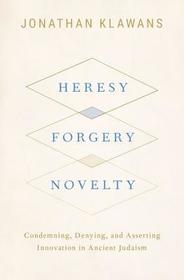
Heresy, Forgery, Novelty
Condemning, Denying, and Asserting Innovation in Ancient Judaism
- Publisher's listprice GBP 102.50
-
46 278 Ft (44 075 Ft + 5% VAT)
The price is estimated because at the time of ordering we do not know what conversion rates will apply to HUF / product currency when the book arrives. In case HUF is weaker, the price increases slightly, in case HUF is stronger, the price goes lower slightly.
- Discount 20% (cc. 9 256 Ft off)
- Discounted price 37 023 Ft (35 260 Ft + 5% VAT)
- Discount is valid until: 30 June 2026
Subcribe now and take benefit of a favourable price.
Subscribe
46 278 Ft

Availability
Estimated delivery time: In stock at the publisher, but not at Prospero's office. Delivery time approx. 3-5 weeks.
Not in stock at Prospero.
Why don't you give exact delivery time?
Delivery time is estimated on our previous experiences. We give estimations only, because we order from outside Hungary, and the delivery time mainly depends on how quickly the publisher supplies the book. Faster or slower deliveries both happen, but we do our best to supply as quickly as possible.
Product details:
- Publisher OUP USA
- Date of Publication 14 October 2019
- ISBN 9780190062507
- Binding Hardback
- No. of pages240 pages
- Size 163x241x22 mm
- Weight 499 g
- Language English 0
Categories
Short description:
It is commonly asserted that heresy is a Christian invention that emerged in late antiquity as Christianity distinguished itself from Judaism. Heresy, Forgery, Novelty clearly defines these three important terms in the study of ancient Judaism and early Christianity, and demonstrates that Christianity's heresiological impulse is in fact indebted to Jewish precedents.
MoreLong description:
It is commonly asserted that heresy is a Christian invention that emerged in late antiquity as Christianity distinguished itself from Judaism. Heresy, Forgery, Novelty probes ancient Jewish disputes regarding religious innovation and argues that Christianity's heresiological impulse is in fact indebted to Jewish precedents.
In this book, Jonathan Klawans demonstrates that ancient Jewish literature displays a profound unease regarding religious innovation. The historian Josephus condemned religious innovation outright, and later rabbis valorize the antiquity of their traditions. The Dead Sea sectarians spoke occasionally-and perhaps secretly-of a "new covenant," but more frequently masked newer ideas in rhetorics of renewal or recovery. Other ancient Jews engaged in pseudepigraphy-the false attribution of recent works to prophets of old. The flourishing of such religious forgeries further underscores the dangers associated with religious innovation.
As Christianity emerged, the discourse surrounding religious novelty shifted dramatically. On the one hand, Christians came to believe that Jesus had inaugurated a "new covenant," replacing what came prior. On the other hand, Christian writers followed their Jewish predecessors in condemning heretics as dangerous innovators, and concealing new works in pseudepigraphic garb. In its open, unabashed embrace of new things, Christianity parts from Judaism. Christianity's heresiological condemnation of novelty, however, displays continuity with prior Jewish traditions. Heresy, Forgery, Novelty reconsiders and offers a new interpretation of the dynamics of the split between Judaism and Christianity.
...this work aims to shed light on the history and nature of inclinations condemning innovation, thereby revealing an overlooked dynamic common to both ancient Judaism and early Christianity.
Table of Contents:
Preface
Acknowledgments
Abbreviations
Chapter 1: Heresies, Forgeries, Novelties
What is New? Anxieties of Innovation, Then and Now
A Tradition of Condemning What is New
A Tradition of Denial: The Constructed Absence of Jewish Heresy
Authoritative Innovation: Prophecy and Scripture
Innovation Revealed and Concealed: Interpretation, Scribes, and Pseudepigraphy
Pseudepigraphy and Forging Antiquity
Heresy, Forgery, Novelty
Chapter 2: Heresy Without Orthodoxy: Josephus and the Rabbis on Dangerous Beliefs
Josephus on the Afterlife: A Possibly Dangerous Hope
Josephus on the Epicureans: Dangerous Denial
Josephus and Jewish Innovation 1: General Denials and Justifications
Constructing and Condemning the Fourth Philosophy
Heresy and Consensus (not Orthodoxy)
Josephus and Jewish Innovation 2: Denials and Falsifications
Heretics in the Mishnah
The Consensus of Pirkei Avot
Conclusion
Chapter 3: Secret Supersessionism? Intimations of Novelty Concealed at Qumran
The New Covenant of the Damascus Document
Novelty, Restoration, and Renewal
Masking Innovation: Remarriage after Divorce and Other New Laws
Covenant Renewal in Jubilees and Qumran
Denying Innovation: The Timelessness of the Two Ways
Secret Supersessionism? A Mysterious Possibility
In the Absence of the Old
Conclusion
Excursus: The New Covenant Inscribed on an Old Stone?
Chapter 4: Innovation Asserted: The Novelties of Early Christianity
Christians, Covenants, and Testaments
A New Covenant in the Gospels and Paul
Innovation and the Teachings of Jesus
The New and Old Covenants in Hebrews
Prophecy and Innovation among the Followers of Jesus
Prophecy, Novelty, and Scripture
An Alternate Discourse: The Timeless Two Ways
Conclusion
Conclusions, Hypotheses and Reflections
Bibliography

