

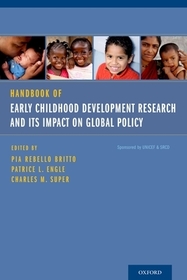
Handbook of Early Childhood Development Research and Its Impact on Global Policy
-
10% KEDVEZMÉNY?
- A kedvezmény csak az 'Értesítés a kedvenc témákról' hírlevelünk címzettjeinek rendeléseire érvényes.
- Kiadói listaár GBP 33.99
-
15 346 Ft (14 615 Ft + 5% áfa)
Az ár azért becsült, mert a rendelés pillanatában nem lehet pontosan tudni, hogy a beérkezéskor milyen lesz a forint árfolyama az adott termék eredeti devizájához képest. Ha a forint romlana, kissé többet, ha javulna, kissé kevesebbet kell majd fizetnie.
- Kedvezmény(ek) 10% (kb. 1 535 Ft)
- Kedvezményes ár 13 811 Ft (13 154 Ft + 5% áfa)
Iratkozzon fel most és részesüljön kedvezőbb árainkból!
Feliratkozom
15 346 Ft

Beszerezhetőség
Megrendelésre a kiadó utánnyomja a könyvet. Rendelhető, de a szokásosnál kicsit lassabban érkezik meg.
Why don't you give exact delivery time?
A beszerzés időigényét az eddigi tapasztalatokra alapozva adjuk meg. Azért becsült, mert a terméket külföldről hozzuk be, így a kiadó kiszolgálásának pillanatnyi gyorsaságától is függ. A megadottnál gyorsabb és lassabb szállítás is elképzelhető, de mindent megteszünk, hogy Ön a lehető leghamarabb jusson hozzá a termékhez.
A termék adatai:
- Kiadó OUP USA
- Megjelenés dátuma 2013. január 31.
- ISBN 9780199922994
- Kötéstípus Puhakötés
- Terjedelem560 oldal
- Méret 231x155x38 mm
- Súly 726 g
- Nyelv angol 0
Kategóriák
Rövid leírás:
Handbook of Early Childhood Development Research and Its Impact on Global Policy calls for placing early childhood development at the top of the global policy agenda, enabling children to achieve their full developmental potential and to contribute to equitable economic and social progress worldwide.
TöbbHosszú leírás:
Early childhood development research offers solutions to several of the world's social and economic problems - solutions that can break the cycle of intergenerational poverty, improve the health, education, and wellbeing of the global population, and yield high rates of return on investment in the formative years of life. And yet over one-third of children worldwide under five years of age still fail to achieve their full developmental potential due to malnutrition, poverty, disease, neglect, and lack of learning opportunities.
Handbook of Early Childhood Development Research and Its Impact on Global Policy calls for placing early childhood development at the top of the global policy agenda, enabling children to achieve their full developmental potential and to contribute to equitable economic and social progress worldwide. The volume presents evidence-based programs and policies for advancing the positive development of young children across the globe, focusing on developing countries. An international ensemble of scholars, policymakers, and practitioners present evidence from multiple disciplinary, sectorial, and analytical perspectives, emphasizing the importance of scientific findings in promoting child development and addressing programmatic challenges to quality, sustainability, measurement, finance, and capacity. Sponsored by the Society for Research in Child Development (SRCD), the premier international association of developmental scientists, and the United Nations Children's Fund (UNICEF), a leading organization for promoting children's wellbeing worldwide, this Handbook will be invaluable to policy advocates, program managers of national governments, international NGOs, and development agencies, as well as to scholars and students in the areas of child development and global policy.
Tartalomjegyzék:
Preface
Acknowledgments
Contributors
SECTION 1: Introduction and Framework for ECD Policies
Chapter 1: Early Child Development: Translating Research to Global Policy.
Pia Rebello Britto, Patrice L. Engle, and Charles M. Super
Chapter 2: The Powerful Reach of Early Childhood Development: A Science-Based Foundation for Sound Investment
Jack P. Shonkoff and Linda Richter
Chapter 3: Situational Analysis of Young Children in a Changing World
Patrice L. Engle, Nirmala Rao, and Oliver Petrovic
Chapter 4: Global Policy Landscape and Early Child Development
Pia Rebello Britto, Nurper Ulkuer, William P. Hodges, and Michael F. McCarthy
SECTION 2: Analytic and Disciplinary Perspectives
Chapter 5: The Nature and Impact of Risk and Protective Influences on Children's Development in Low Income Countries
Theodore D. Wachs and Atif Rahman
Chapter 6: Economic Perspectives on Some Important Dimensions of Early Childhood Development in Developing Countries
Jere R. Behrman and Sergio S. Urzua
Chapter 7: Culture and Early Childhood Development: Implications for Policy and Programs
Sara Harkness, Charles M. Super, Caroline Johnston Mavridis, Oumar Barry, and Marian Zeitlin
Chapter 8: Voices Less Heard: The Importance of Critical and "Indigenous " Perspectives
Alan Pence
SECTION 3: Programmatic Approaches to ECD
Chapter 9: The Role of the Health Sector in Early Childhood Development
Patrice L. Engle, Mary E. Young, and Giorgio Tamburlini
Chapter 10: Nutrition Based Approaches to Early Childhood Development
Aisha K. Yousafzai, Mohammad Y. Yakoob, and Zulfiqar A. Bhutta
Chapter 11: Education Based Approaches to Early Childhood Development
Chloe O'Gara
Chapter 12: Preventing Violence against Young Children
Cassie Landers, Clarice Da Silva e Paula, and Theresa Kilbane
Chapter 13: Social Protection and Welfare Systems: Implications for Early Childhood Development
Lawrence Aber, Linda Biersteker, Andrew Dawes, and Laura Rawlings
Chapter 14: Community Based Approaches to ECD: A Matter of Degree
Jacqueline Hayden and Sithu Wai
Chapter 15: Parents and Communities: The Key to Understanding "Faith Based " Early Childhood Services and Programs
Kathy Bartlett, Paul Stephenson, and Louie Cadaing
Chapter 16: Early Education for All: Is there a Role for the Private Sector?
Martin Woodhead and Natalia Streuli
Chapter 17: Media and Early Childhood Development
Daphna Lemish and Barbara Kolucki
SECTION 4: Measurement and Monitoring of Programs and Policies
Chapter 18: Assessing Early Child Development
Marc H. Bornstein and Jennifer E Lansford
Chapter 19: Monitoring Progress Towards the Fulfillment of Rights in Early Childhood Under the Convention on the Rights of the Child to Improve Outcomes for Children and Families
Clyde Hertzman, Ziba Vaghri, and Adem Arkadas
Chapter 20: Improving Policies and Programs for Educational Quality: An Example from the Use of Learning Assessments
Dan A. Wagner
SECTION 5: Building and Strengthening the ECD Programs
Chapter 21: National Agency Systems
Maha B. Homsi and Lara A. Hussein
Chapter 22: Capacity Building for Early Child Development
Sara L. Hommel
Chapter 23: Barriers to Service Provision: Lessons Learned from Donor-Supported Early Child Development (ECD) Projects
Mary E. Young
Chapter 24: Building and Strengthening National Systems for Early Childhood Development
Emily Vargas-Barón
Chapter 25: Effective Financing
Alexandria Valerio and Marito H. Garcia
SECTION 6: Conclusions
Chapter 26: Paradigm Shifts and New Directions in Research on Early Child Development Programs in Low- and Middle-Income Countries
Hirokazu Yoshikawa and Ana Maria Nieto
Chapter 27: Closing Commentary: Implications for Development
Deepa Grover
Chapter 28: Closing Commentary: Implications for Capacity
Aster Haregot
Chapter 29: Closing Commentary: The Future of ECD in the Global Development Agenda
Charles M. Super, Pia Rebello Britto, and Patrice L. Engle

