

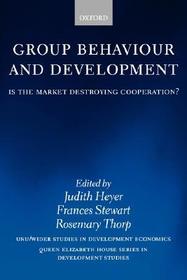
Group Behaviour and Development
Is the Market Destroying Cooperation?
Sorozatcím: WIDER Studies in Development Economics;
-
10% KEDVEZMÉNY?
- A kedvezmény csak az 'Értesítés a kedvenc témákról' hírlevelünk címzettjeinek rendeléseire érvényes.
- Kiadói listaár GBP 55.00
-
24 832 Ft (23 650 Ft + 5% áfa)
Az ár azért becsült, mert a rendelés pillanatában nem lehet pontosan tudni, hogy a beérkezéskor milyen lesz a forint árfolyama az adott termék eredeti devizájához képest. Ha a forint romlana, kissé többet, ha javulna, kissé kevesebbet kell majd fizetnie.
- Kedvezmény(ek) 10% (cc. 2 483 Ft off)
- Kedvezményes ár 22 349 Ft (21 285 Ft + 5% áfa)
Iratkozzon fel most és részesüljön kedvezőbb árainkból!
Feliratkozom
24 832 Ft

Beszerezhetőség
Megrendelésre a kiadó utánnyomja a könyvet. Rendelhető, de a szokásosnál kicsit lassabban érkezik meg.
Why don't you give exact delivery time?
A beszerzés időigényét az eddigi tapasztalatokra alapozva adjuk meg. Azért becsült, mert a terméket külföldről hozzuk be, így a kiadó kiszolgálásának pillanatnyi gyorsaságától is függ. A megadottnál gyorsabb és lassabb szállítás is elképzelhető, de mindent megteszünk, hogy Ön a lehető leghamarabb jusson hozzá a termékhez.
A termék adatai:
- Kiadó OUP Oxford
- Megjelenés dátuma 2002. szeptember 19.
- ISBN 9780199256921
- Kötéstípus Puhakötés
- Terjedelem384 oldal
- Méret 234x156x21 mm
- Súly 557 g
- Nyelv angol
- Illusztrációk numerous tables and figures 0
Kategóriák
Rövid leírás:
A substantial introduction to the study of group behaviour in developing countries. Groups account for the majority of economic decisions, yet this remains a relatively neglected area of study. This book provides both relevant theoretical issues and eleven case studies. The authors explore what determines modes of behaviour of groups, and the consequences for efficiency, equity, and well-being, concluding that the universal presumption in favour of material incentives needs to be abandoned and cooperation supported if markets and groups are to function well and in an equity-friendly direction.
TöbbHosszú leírás:
This book focuses on group behaviour in developing countries. It includes studies of producer and community organizations, NGOs, and some public sector groups.
Despite the fact that most economic decisions are taken by people acting within groups -- families, firms, neighbourhood or community associations, and networks of producers -- the analysis of group functioning has not received enough attention, particularly among economists.
Some groups function well, from the perspectives of equity, efficiency, and well-being, while others do not. This book explores why. It covers groups that perform three types of function: overcoming market failures (e.g. producer organizations); improving the position of their members (e.g. Trade Unions), and distributing resources to the less well-off (e.g. NGOs and the public sector). It contrasts three modes of group behaviour: power and control; cooperation; and the use of material incentives. It explores what determines modes of behaviour of groups, and the consequences for efficiency, equity, and well-being.
The book includes eleven case studies by different authors, including producers' associations in Brazil, farmers' organizations in Korea and Taiwan, community forestry groups in South Asia, organizations of sex-workers in Calcutta, and health NGOs in Uganda. Claims groups tended to be the most cooperative, cooperation fostering empowerment and self-esteem. Distributive or pro bono groups mostly operated according to power and control, while market failure groups often combined all three modes.
The studies show the strong impact of norms in society as a whole on group behaviour. The recent shift towards a stronger role for market incentives has exerted powerful pressures on groups to use more material incentives, undermining the cooperation essential to sustain efficiency and equity. The universal presumption in favour of monetary incentives needs to be abandoned. Non-market behaviour needs to be valued and protected as well.
... an exceptionally useful resource for practitioners and researchers interested in collective action issues.
Tartalomjegyzék:
Group Behaviour and Development
Dynamic Interactions Between the Macro-environment, Development Thinking, and Group Behaviour
Individual Motivation, its Nature, Determinants, and Consequences for Within-group Behaviour
Collective Action for Local-Level Effort Regulation: An Assessment of Recent Experiences in Senegalese Small-Scale Fisheries
Leaders and Intermediaries as Economic Development Agents in Producers' Associations
Group Behaviour and Development: A Comparison of Farmers' Organizations in South Korea and Taiwan
Has the Coffee Federation Become Redundant? Collective Action and the Market in Colombian Development
Producer Groups and the Decollectivization of the Mongolian Pastoral Economy
The Hidden Side of Group Behaviour: A Gender Analysis of Community Forestry in South Asia
Information Women's Groups in Rural Bangladesh: Group Operation and Outcomes
Sex Workers in Calcutta and the Dynamics of Collective Action: Political Activism, Community Identity, and Group Behaviour
Non-market Relationships in Health Care
Institutional Cultures and Regulatory Relationships in a Liberalizing Health Care System: A Tanzanian Case Study
The Case of Indigenous NGOs in Uganda's Health Sector
Conclusions

