

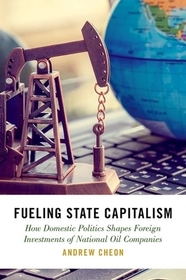
Fueling State Capitalism
How Domestic Politics Shapes Foreign Investments of National Oil Companies
Sorozatcím: STUDIES COMPAR ENERGY ENVIRON POL SERIES;
-
10% KEDVEZMÉNY?
- A kedvezmény csak az 'Értesítés a kedvenc témákról' hírlevelünk címzettjeinek rendeléseire érvényes.
- Kiadói listaár GBP 57.00
-
25 735 Ft (24 510 Ft + 5% áfa)
Az ár azért becsült, mert a rendelés pillanatában nem lehet pontosan tudni, hogy a beérkezéskor milyen lesz a forint árfolyama az adott termék eredeti devizájához képest. Ha a forint romlana, kissé többet, ha javulna, kissé kevesebbet kell majd fizetnie.
- Kedvezmény(ek) 10% (cc. 2 574 Ft off)
- Kedvezményes ár 23 162 Ft (22 059 Ft + 5% áfa)
Iratkozzon fel most és részesüljön kedvezőbb árainkból!
Feliratkozom
25 735 Ft

Beszerezhetőség
Becsült beszerzési idő: A Prosperónál jelenleg nincsen raktáron, de a kiadónál igen. Beszerzés kb. 3-5 hét..
A Prosperónál jelenleg nincsen raktáron.
Why don't you give exact delivery time?
A beszerzés időigényét az eddigi tapasztalatokra alapozva adjuk meg. Azért becsült, mert a terméket külföldről hozzuk be, így a kiadó kiszolgálásának pillanatnyi gyorsaságától is függ. A megadottnál gyorsabb és lassabb szállítás is elképzelhető, de mindent megteszünk, hogy Ön a lehető leghamarabb jusson hozzá a termékhez.
A termék adatai:
- Kiadó OUP USA
- Megjelenés dátuma 2023. május 24.
- ISBN 9780197672884
- Kötéstípus Keménykötés
- Terjedelem200 oldal
- Méret 162x239x16 mm
- Súly 435 g
- Nyelv angol 406
Kategóriák
Rövid leírás:
In the late 1990s, governments began investing hundreds of billions of dollars in foreign oil and gas assets through their national oil companies (NOCs), raising concerns about a "resource war" and asymmetric interdependence. Most critics perceive the foreign investments of NOCs as politically driven and inefficient. In Fueling State Capitalism, however, Andrew Cheon sees these investments as commercial ventures by ambitious state-owned enterprises seeking to become global players amid rising oil prices. Looking at investments from 79 countries from 2000 to 2013, as well as case studies of China, India, Brazil, Norway, and Russia, Fueling State Capitalism unpacks the role of domestic institutions, both national and bureaucratic, in shaping the global expansion of national energy firms.
TöbbHosszú leírás:
In the late 1990s, governments began investing hundreds of billions of dollars in foreign oil and gas assets through their national oil companies (NOCs), raising concerns about a "resource war" and asymmetric interdependence. Most critics perceive the foreign investments of NOCs as politically driven and inefficient. In Fueling State Capitalism, however, Andrew Cheon sees these investments as commercial ventures by ambitious state-owned enterprises seeking to become global players amid rising oil prices. Some have invested aggressively abroad, often in politically risky destinations, whereas others have been more moderate in their ambitions. The NOCs' capacity to pursue foreign investments varies, as Cheon argues, according to regime types and bureaucratic structures of their governments.
Using principal agent theory, Cheon shows that competition among NOCs' principals at two different levels of government--national and bureaucratic--conditions the foreign investments of NOCs. While competition between the chief executive and opposition parties can limit democratic governments' capacity to tolerate failed investments abroad, non-democratic governments are less constrained. An overlap of authority among bureaucratic institutions can also encourage counterproductive behavior among NOCs, whereas a clear line of authority among them can prevent it.
Looking at investments from 79 countries from 2000 to 2013, as well as case studies of China, India, Brazil, Norway, and Russia, Fueling State Capitalism unpacks the role of institutions, both national and bureaucratic, in shaping the global expansion of national energy firms. Moreover, Cheon probes the energy security motivations of NOC investments and the origins of bureaucratic structures. Based on the experience of NOC global expansion, Cheon concludes that bureaucratic institutions will be critical in achieving decarbonization that not only allows governments to meet their political objectives, but also helps NOCs ensure their long-term commercial viability through a managed transition to renewable energy.
In Fueling State Capitalism, Andrew Cheon rightly focuses our attention on a crucial part of the global economy: national oil companies. Over the past two decades, these state-owned enterprises strode forth from China, Russia, and elsewhere, with political and economic effects all over the world. Cheon gives us a guide for understanding these developments.
Tartalomjegyzék:
1. Introduction
2. The Baseline: Political and Economic Drivers
3. Domestic Structure and NOC Global Expansion
4. Do Institutions Matter? A Quantitative Analysis
5. Bureaucratic Competition in China and India
6. Designated Principals in Brazil and Norway
7. The Complicated Case of Russia
8. Professionalization as an Alternative Explanation
9. Conclusion and Implications

