

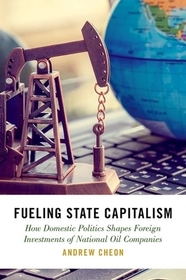
Fueling State Capitalism
How Domestic Politics Shapes Foreign Investments of National Oil Companies
Series: STUDIES COMPAR ENERGY ENVIRON POL SERIES;
- Publisher's listprice GBP 57.00
-
25 735 Ft (24 510 Ft + 5% VAT)
The price is estimated because at the time of ordering we do not know what conversion rates will apply to HUF / product currency when the book arrives. In case HUF is weaker, the price increases slightly, in case HUF is stronger, the price goes lower slightly.
- Discount 10% (cc. 2 574 Ft off)
- Discounted price 23 162 Ft (22 059 Ft + 5% VAT)
Subcribe now and take benefit of a favourable price.
Subscribe
25 735 Ft

Availability
Estimated delivery time: In stock at the publisher, but not at Prospero's office. Delivery time approx. 3-5 weeks.
Not in stock at Prospero.
Why don't you give exact delivery time?
Delivery time is estimated on our previous experiences. We give estimations only, because we order from outside Hungary, and the delivery time mainly depends on how quickly the publisher supplies the book. Faster or slower deliveries both happen, but we do our best to supply as quickly as possible.
Product details:
- Publisher OUP USA
- Date of Publication 24 May 2023
- ISBN 9780197672884
- Binding Hardback
- No. of pages200 pages
- Size 162x239x16 mm
- Weight 435 g
- Language English 406
Categories
Short description:
In the late 1990s, governments began investing hundreds of billions of dollars in foreign oil and gas assets through their national oil companies (NOCs), raising concerns about a "resource war" and asymmetric interdependence. Most critics perceive the foreign investments of NOCs as politically driven and inefficient. In Fueling State Capitalism, however, Andrew Cheon sees these investments as commercial ventures by ambitious state-owned enterprises seeking to become global players amid rising oil prices. Looking at investments from 79 countries from 2000 to 2013, as well as case studies of China, India, Brazil, Norway, and Russia, Fueling State Capitalism unpacks the role of domestic institutions, both national and bureaucratic, in shaping the global expansion of national energy firms.
MoreLong description:
In the late 1990s, governments began investing hundreds of billions of dollars in foreign oil and gas assets through their national oil companies (NOCs), raising concerns about a "resource war" and asymmetric interdependence. Most critics perceive the foreign investments of NOCs as politically driven and inefficient. In Fueling State Capitalism, however, Andrew Cheon sees these investments as commercial ventures by ambitious state-owned enterprises seeking to become global players amid rising oil prices. Some have invested aggressively abroad, often in politically risky destinations, whereas others have been more moderate in their ambitions. The NOCs' capacity to pursue foreign investments varies, as Cheon argues, according to regime types and bureaucratic structures of their governments.
Using principal agent theory, Cheon shows that competition among NOCs' principals at two different levels of government--national and bureaucratic--conditions the foreign investments of NOCs. While competition between the chief executive and opposition parties can limit democratic governments' capacity to tolerate failed investments abroad, non-democratic governments are less constrained. An overlap of authority among bureaucratic institutions can also encourage counterproductive behavior among NOCs, whereas a clear line of authority among them can prevent it.
Looking at investments from 79 countries from 2000 to 2013, as well as case studies of China, India, Brazil, Norway, and Russia, Fueling State Capitalism unpacks the role of institutions, both national and bureaucratic, in shaping the global expansion of national energy firms. Moreover, Cheon probes the energy security motivations of NOC investments and the origins of bureaucratic structures. Based on the experience of NOC global expansion, Cheon concludes that bureaucratic institutions will be critical in achieving decarbonization that not only allows governments to meet their political objectives, but also helps NOCs ensure their long-term commercial viability through a managed transition to renewable energy.
In Fueling State Capitalism, Andrew Cheon rightly focuses our attention on a crucial part of the global economy: national oil companies. Over the past two decades, these state-owned enterprises strode forth from China, Russia, and elsewhere, with political and economic effects all over the world. Cheon gives us a guide for understanding these developments.
Table of Contents:
1. Introduction
2. The Baseline: Political and Economic Drivers
3. Domestic Structure and NOC Global Expansion
4. Do Institutions Matter? A Quantitative Analysis
5. Bureaucratic Competition in China and India
6. Designated Principals in Brazil and Norway
7. The Complicated Case of Russia
8. Professionalization as an Alternative Explanation
9. Conclusion and Implications

