

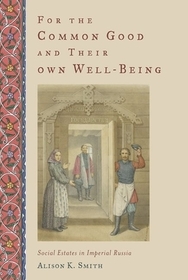
For the Common Good and Their Own Well-Being
Social Estates in Imperial Russia
-
10% KEDVEZMÉNY?
- A kedvezmény csak az 'Értesítés a kedvenc témákról' hírlevelünk címzettjeinek rendeléseire érvényes.
- Kiadói listaár GBP 25.99
-
11 734 Ft (11 175 Ft + 5% áfa)
Az ár azért becsült, mert a rendelés pillanatában nem lehet pontosan tudni, hogy a beérkezéskor milyen lesz a forint árfolyama az adott termék eredeti devizájához képest. Ha a forint romlana, kissé többet, ha javulna, kissé kevesebbet kell majd fizetnie.
- Kedvezmény(ek) 10% (kb. 1 174 Ft)
- Kedvezményes ár 10 560 Ft (10 058 Ft + 5% áfa)
Iratkozzon fel most és részesüljön kedvezőbb árainkból!
Feliratkozom
11 734 Ft

Beszerezhetőség
Becsült beszerzési idő: A Prosperónál jelenleg nincsen raktáron, de a kiadónál igen. Beszerzés kb. 3-5 hét..
A Prosperónál jelenleg nincsen raktáron.
Why don't you give exact delivery time?
A beszerzés időigényét az eddigi tapasztalatokra alapozva adjuk meg. Azért becsült, mert a terméket külföldről hozzuk be, így a kiadó kiszolgálásának pillanatnyi gyorsaságától is függ. A megadottnál gyorsabb és lassabb szállítás is elképzelhető, de mindent megteszünk, hogy Ön a lehető leghamarabb jusson hozzá a termékhez.
A termék adatai:
- Kiadó OUP USA
- Megjelenés dátuma 2018. november 22.
- ISBN 9780190939625
- Kötéstípus Puhakötés
- Terjedelem292 oldal
- Méret 152x231x20 mm
- Súly 476 g
- Nyelv angol
- Illusztrációk 3 illus. 0
Kategóriák
Rövid leírás:
Every subject of the Russian Empire had an official, legal place in society marked by his or her social estate, or soslovie. This book looks at the many ways that soslovie affected individual lives, and traces its legislation and administration from the early eighteenth through to the early twentieth century.
TöbbHosszú leírás:
Every subject of the Russian Empire had an official, legal place in society marked by his or her social estate, or soslovie. These sosloviia (noble, peasant, merchant, and many others) were usually inherited, and defined the rights, opportunities, and duties of those who possessed them. They were also usually associated with membership in a specific geographically defined society in a particular town or village. Moreover, although laws increasingly insisted that every subject of the empire possess a soslovie "for the common good and their own well-being," they also allowed individuals to change their soslovie by following a particular bureaucratic procedure. The process of changing soslovie brought together three sets of actors: the individuals who wished to change their opportunities or duties, or who at times had change forced upon them; local societies, which wished to control who belonged to them; and the central, imperial state, which wished above all to ensure that every one of its subjects had a place, and therefore a status. This book looks at the many ways that soslovie could affect individual lives and have meaning, then traces the legislation and administration of soslovie from the early eighteenth through to the early twentieth century. This period saw a shift from soslovie as above all a means of extracting duties or taxes, to an understanding of soslovie as instead a means of providing services and ensuring security. The book ends with an examination of the way that a change in soslovie could affect not just an individual's biography, but the future of his or her entire family. The result is a new image of soslovie as both a general and a very specific identity, and as one that had persistent meaning, for the Imperial statue, for local authorities, or for individual subjects, even through 1917.
Smith clearly demonstrates that the soslovie system remained at once both vital and obsolete.
Tartalomjegyzék:
Contents
Preface and Acknowledgments
Introduction
Chapter 1: The Meaning of Soslovie
Chapter 2: Legal Standards and Administrative Reality: Local Interests and
Central Ideals in the 18th Century
Chapter 3:The Freedom to Choose and the Right to Refuse
Chapter 4: Communities and Individuals: Soslovie Societies and their Members
Chapter 5: The Death and Life of Sosloviia in the Post-Reform Empire
Chapter 6:The Evolution of Collective Responsibility
Chapter 7: Soslovie in Context: Life Stories
Conclusion
Appendix: Archival Sources
Selected Bibliography
Notes
Index

