

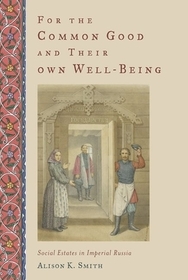
For the Common Good and Their Own Well-Being
Social Estates in Imperial Russia
- Publisher's listprice GBP 25.99
-
11 734 Ft (11 175 Ft + 5% VAT)
The price is estimated because at the time of ordering we do not know what conversion rates will apply to HUF / product currency when the book arrives. In case HUF is weaker, the price increases slightly, in case HUF is stronger, the price goes lower slightly.
- Discount 10% (cc. 1 174 Ft off)
- Discounted price 10 560 Ft (10 058 Ft + 5% VAT)
Subcribe now and take benefit of a favourable price.
Subscribe
11 734 Ft

Availability
Estimated delivery time: In stock at the publisher, but not at Prospero's office. Delivery time approx. 3-5 weeks.
Not in stock at Prospero.
Why don't you give exact delivery time?
Delivery time is estimated on our previous experiences. We give estimations only, because we order from outside Hungary, and the delivery time mainly depends on how quickly the publisher supplies the book. Faster or slower deliveries both happen, but we do our best to supply as quickly as possible.
Product details:
- Publisher OUP USA
- Date of Publication 22 November 2018
- ISBN 9780190939625
- Binding Paperback
- No. of pages292 pages
- Size 152x231x20 mm
- Weight 476 g
- Language English
- Illustrations 3 illus. 0
Categories
Short description:
Every subject of the Russian Empire had an official, legal place in society marked by his or her social estate, or soslovie. This book looks at the many ways that soslovie affected individual lives, and traces its legislation and administration from the early eighteenth through to the early twentieth century.
MoreLong description:
Every subject of the Russian Empire had an official, legal place in society marked by his or her social estate, or soslovie. These sosloviia (noble, peasant, merchant, and many others) were usually inherited, and defined the rights, opportunities, and duties of those who possessed them. They were also usually associated with membership in a specific geographically defined society in a particular town or village. Moreover, although laws increasingly insisted that every subject of the empire possess a soslovie "for the common good and their own well-being," they also allowed individuals to change their soslovie by following a particular bureaucratic procedure. The process of changing soslovie brought together three sets of actors: the individuals who wished to change their opportunities or duties, or who at times had change forced upon them; local societies, which wished to control who belonged to them; and the central, imperial state, which wished above all to ensure that every one of its subjects had a place, and therefore a status. This book looks at the many ways that soslovie could affect individual lives and have meaning, then traces the legislation and administration of soslovie from the early eighteenth through to the early twentieth century. This period saw a shift from soslovie as above all a means of extracting duties or taxes, to an understanding of soslovie as instead a means of providing services and ensuring security. The book ends with an examination of the way that a change in soslovie could affect not just an individual's biography, but the future of his or her entire family. The result is a new image of soslovie as both a general and a very specific identity, and as one that had persistent meaning, for the Imperial statue, for local authorities, or for individual subjects, even through 1917.
Smith clearly demonstrates that the soslovie system remained at once both vital and obsolete.
Table of Contents:
Contents
Preface and Acknowledgments
Introduction
Chapter 1: The Meaning of Soslovie
Chapter 2: Legal Standards and Administrative Reality: Local Interests and
Central Ideals in the 18th Century
Chapter 3:The Freedom to Choose and the Right to Refuse
Chapter 4: Communities and Individuals: Soslovie Societies and their Members
Chapter 5: The Death and Life of Sosloviia in the Post-Reform Empire
Chapter 6:The Evolution of Collective Responsibility
Chapter 7: Soslovie in Context: Life Stories
Conclusion
Appendix: Archival Sources
Selected Bibliography
Notes
Index

