

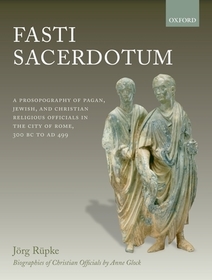
Fasti Sacerdotum
A Prosopography of Pagan, Jewish, and Christian Religious Officials in the City of Rome, 300 BC to AD 499
-
10% KEDVEZMÉNY?
- A kedvezmény csak az 'Értesítés a kedvenc témákról' hírlevelünk címzettjeinek rendeléseire érvényes.
- Kiadói listaár GBP 697.50
-
314 921 Ft (299 925 Ft + 5% áfa)
Az ár azért becsült, mert a rendelés pillanatában nem lehet pontosan tudni, hogy a beérkezéskor milyen lesz a forint árfolyama az adott termék eredeti devizájához képest. Ha a forint romlana, kissé többet, ha javulna, kissé kevesebbet kell majd fizetnie.
- Kedvezmény(ek) 10% (kb. 31 492 Ft)
- Kedvezményes ár 283 429 Ft (269 933 Ft + 5% áfa)
Iratkozzon fel most és részesüljön kedvezőbb árainkból!
Feliratkozom
314 921 Ft

Beszerezhetőség
Megrendelésre a kiadó utánnyomja a könyvet. Rendelhető, de a szokásosnál kicsit lassabban érkezik meg.
Why don't you give exact delivery time?
A beszerzés időigényét az eddigi tapasztalatokra alapozva adjuk meg. Azért becsült, mert a terméket külföldről hozzuk be, így a kiadó kiszolgálásának pillanatnyi gyorsaságától is függ. A megadottnál gyorsabb és lassabb szállítás is elképzelhető, de mindent megteszünk, hogy Ön a lehető leghamarabb jusson hozzá a termékhez.
A termék adatai:
- Kiadó OUP Oxford
- Megjelenés dátuma 2008. október 30.
- ISBN 9780199291137
- Kötéstípus Keménykötés
- Terjedelem1120 oldal
- Méret 253x194x63 mm
- Súly 2270 g
- Nyelv angol 0
Kategóriák
Rövid leírás:
This magisterial volume, indispensable to the study of Roman religion, presents yearly lists of religious office-holders of various kinds, followed by 4,000 individual biographies. Introductory essays cover the documentary sources for pagan, Jewish, and Christian cults; concluding chapters explore the relationship between religion and the state.
TöbbHosszú leírás:
This magisterial compilation personalizes and historicizes the history of religion in the city of Rome. After introductory essays on the documentary sources for the various Greek, Roman, Oriental, Jewish, and Christian cults in question, there are yearly lists of religious office-holders of various kinds, followed by 4,000 biographies of individuals who fulfilled ritual, organizational, or doctrinal roles. Concluding chapters discuss important aspects of Roman religion and its relationship with the state. The data assembled here will open up many new perspectives: on the social place of religion and certain cults, on the interplay between different religious groups, and on the organizational history of individual cults. The volume as a whole signifies a major advance in our understanding of ancient religions.
Rüpke is to be congratulated on providing all scholars with a major research tool that I am sure will open up new avenues of study for many years to come in the same way that Broughton's work continues to do. I congratulate and salute the author and his team of advisors for completing such a massive project and for producing a remarkably useful resource. The work is an indispensable research tool for all historians of ancient Rome.

