

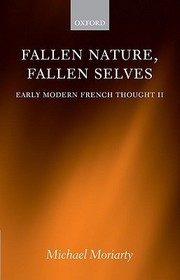
Fallen Nature, Fallen Selves
Early Modern French Thought II
-
10% KEDVEZMÉNY?
- A kedvezmény csak az 'Értesítés a kedvenc témákról' hírlevelünk címzettjeinek rendeléseire érvényes.
- Kiadói listaár GBP 205.00
-
92 557 Ft (88 150 Ft + 5% áfa)
Az ár azért becsült, mert a rendelés pillanatában nem lehet pontosan tudni, hogy a beérkezéskor milyen lesz a forint árfolyama az adott termék eredeti devizájához képest. Ha a forint romlana, kissé többet, ha javulna, kissé kevesebbet kell majd fizetnie.
- Kedvezmény(ek) 10% (cc. 9 256 Ft off)
- Kedvezményes ár 83 302 Ft (79 335 Ft + 5% áfa)
Iratkozzon fel most és részesüljön kedvezőbb árainkból!
Feliratkozom
92 557 Ft

Beszerezhetőség
Megrendelésre a kiadó utánnyomja a könyvet. Rendelhető, de a szokásosnál kicsit lassabban érkezik meg.
Why don't you give exact delivery time?
A beszerzés időigényét az eddigi tapasztalatokra alapozva adjuk meg. Azért becsült, mert a terméket külföldről hozzuk be, így a kiadó kiszolgálásának pillanatnyi gyorsaságától is függ. A megadottnál gyorsabb és lassabb szállítás is elképzelhető, de mindent megteszünk, hogy Ön a lehető leghamarabb jusson hozzá a termékhez.
A termék adatai:
- Kiadó OUP Oxford
- Megjelenés dátuma 2006. május 25.
- ISBN 9780199291038
- Kötéstípus Keménykötés
- Terjedelem450 oldal
- Méret 223x146x30 mm
- Súly 672 g
- Nyelv angol 0
Kategóriák
Rövid leírás:
An investigation of psychological and ethical thought in seventeenth-century France, emphasizing both continuities and discontinuities with ancient and medieval thought. It demonstrates the subtlety and complexity of psychological analysis that characterizes the period and shows how religious doctrines affected ethical and psychological thought.
TöbbHosszú leírás:
From the late sixteenth to the late seventeenth centuries, French writing is especially concerned with analysing human nature. The ancient ethical vision of man's nature and goal (we achieve fulfilment by living our lives according to reason, the highest and noblest element of our nature) survives, even, to some extent, in Descartes. But it is put into question especially by the revival of St Augustine's thought, which focuses on the contradictions and disorders of human desires and aspirations. Analyses of behaviour display a powerful suspicion of appearances. Human beings are increasingly seen as motivated by self-love: they are driven by the desire for their own advantage, and take a narcissistic delight in their own image. Moral and religious writers re-emphasize the traditional imperative of self-knowledge, but in such a way as to suggest the difficulties of knowing oneself. Operating with the Cartesian distinction between mind and body, they emphasize the imperceptible influence of bodily processes on our thought and attitudes. They analyse human beings' ignorance (due to self-love) of their own motives and qualities, and the illusions under which they live their lives. Their critique of human behaviour is no less searching than that of writers who have broken with traditional religious morality, such as Hobbes and Spinoza. A wide range of authors is studied, some well-known, others much less so: the abstract and general analyses of philosophers and theologians (Descartes, Jansenius, Malebranche) are juxtaposed with the less systematic and more concrete investigations of writers like Montaigne and La Rochefoucauld, not to mention the theatre of Corneille, Moli?re, and Racine.
...it will be difficult in future to address the concerns that are explored in this bipartite enterprise without making reference to his enlightening, lucid and oftern engagingly individual treatment of them.
Tartalomjegyzék:
Part One: Human Nature
Approaches
Original Sin
Part Two: Self-Love and Concupiscence
Early Modern Religious Perspectives
La Rochefoucauld on Interest and Self-Love
Malebranche's Synthesis
Part Three: Problems of Self-Knowledge
Forms of Self-Knowledge
Literary Explorations
Self-Knowledge and Self-Ignorance in Context
La Rochefoucauld and Self-Knowledge
Religious Moralists

