

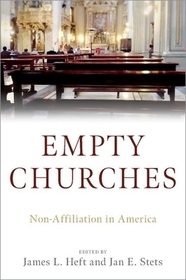
Empty Churches
Non-Affiliation in America
-
20% KEDVEZMÉNY?
- A kedvezmény csak az 'Értesítés a kedvenc témákról' hírlevelünk címzettjeinek rendeléseire érvényes.
- Kiadói listaár GBP 33.99
-
15 346 Ft (14 615 Ft + 5% áfa)
Az ár azért becsült, mert a rendelés pillanatában nem lehet pontosan tudni, hogy a beérkezéskor milyen lesz a forint árfolyama az adott termék eredeti devizájához képest. Ha a forint romlana, kissé többet, ha javulna, kissé kevesebbet kell majd fizetnie.
- Kedvezmény(ek) 20% (cc. 3 069 Ft off)
- Kedvezményes ár 12 277 Ft (11 692 Ft + 5% áfa)
- A kedvezmény érvényes eddig: 2026. június 30.
Iratkozzon fel most és részesüljön kedvezőbb árainkból!
Feliratkozom
15 346 Ft

Beszerezhetőség
Becsült beszerzési idő: A Prosperónál jelenleg nincsen raktáron, de a kiadónál igen. Beszerzés kb. 3-5 hét..
A Prosperónál jelenleg nincsen raktáron.
Why don't you give exact delivery time?
A beszerzés időigényét az eddigi tapasztalatokra alapozva adjuk meg. Azért becsült, mert a terméket külföldről hozzuk be, így a kiadó kiszolgálásának pillanatnyi gyorsaságától is függ. A megadottnál gyorsabb és lassabb szállítás is elképzelhető, de mindent megteszünk, hogy Ön a lehető leghamarabb jusson hozzá a termékhez.
A termék adatai:
- Kiadó OUP USA
- Megjelenés dátuma 2021. március 31.
- ISBN 9780197529324
- Kötéstípus Puhakötés
- Terjedelem384 oldal
- Méret 231x155x27 mm
- Súly 567 g
- Nyelv angol 92
Kategóriák
Rövid leírás:
Empty Churches studies the growing number of individuals who no longer affiliate with a religious tradition. Co-editors Jan E. Stets, a social psychologist, and James L. Heft, a historian of theology, bring together leading scholars across the humanities and social sciences, who explore the phenomenon of non-affiliation by drawing from each other's work to understand better the multi-faceted nature of non-affiliation today.
TöbbHosszú leírás:
Based in the idea that social phenomena are best studied through the lens of different disciplinary perspectives, Empty Churches studies the growing number of individuals who no longer affiliate with a religious tradition. Co-editors Jan Stets, a social psychologist, and James Heft, a historian of theology, bring together leading scholars in the fields of sociology, developmental psychology, gerontology, political science, history, philosophy, and pastoral theology.
The scholars in this volume explore the phenomenon by drawing from each other's work to understand better the multi-faceted nature of non-affiliation today. They explore the complex impact that non-affiliation has on individuals and the wider society, and what the future looks like for religion in America. The book also features insightful perspectives from parents of young adults and interviews with pastors struggling with this issue who address how we might address this trend. Empty Churches provides a rich and thoughtful analysis on non- affiliation in American society from multiple scholarly perspectives. The increasing growth of non-affiliation threatens the vitality and long-term stability of religious institutions, and this book offers guidance on maintaining the commitment and community at the heart of these institutions.
Prefaced by the Bishop of San Diego, this important interdisciplinary study co-directed by a theologian (James L. Heft) and a sociologist (Jan E. Stets) attempts to understand the phenomenon of religious disaffiliation which, after having affected European countries, manifests itself today in the United States, more or less spared on this point until now.
Tartalomjegyzék:
Preface: Robert M. McElroy, Bishop of San Diego
Chapter 1: Introduction: An Interdisciplinary Analysis of Non-Affiliation
Jan E. Stets, University of California, Riverside
WHO ARE THEY?
Chapter 2: The Many Meanings of Non-Affiliation
Nancy Ammerman, Boston University
Chapter 3: The Many Meanings of the Secular
Joseph O. Baker, East Tennessee State University
Chapter 4: Lapsed Catholics and Other Religious Non-Affiliates
Carol Ann MacGregor and Ashlyn Haycook, Loyola University New Orleans
Chapter 5: Affiliates and Non-Affiliates in Later Life
Vern Bengtson, University of Southern California, and Gabrielle Gonzales, Camille Endacott, and Samantha Copping Kang, University of California, Santa Barbara
WHERE DO THEY COME FROM?
Chapter 6: Developmental Views on Youth Religious Non-Affiliation
Sam A. Hardy, Brigham Young University and Gregory S. Longo, Eastern University
Chapter 7: Religious Non-Affiliation: Expelled by the Right
William V. Trollinger, University of Dayton
Chapter 8: The Transformation of Religion: Drawn by the Left
Matthew S. Hedstrom, University of Virginia
WHAT ARE SOME CONSEQUENCES?
Chapter 9: Non-religiosity, Secularism, and Civil Society
David E. Campbell, University of Notre Dame
Chapter 10: Religious Non-Affiliation and Objections of Conscience
Bernard G. Prusak, King's College
ADDRESSING THE CHALLENGE
Chapter 11: Reports from Faith Community Leaders in the South
Elizabeth Kirkland Cahill
Chapter 12: Cultivating Faith in Young Adults
Kerry A. Robinson, Leadership Roundtable
Chapter 13: Understanding and Responding to Non-Affiliation
James L. Heft, University of Southern California
Epilogue:
Jan E. Stets, University of California, Riverside and James L. Heft, University of Southern California
Notes
Index

