

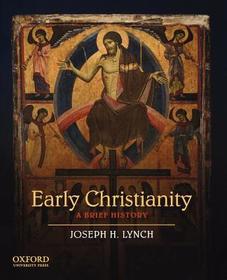
Early Christianity
A Brief History
-
10% KEDVEZMÉNY?
- A kedvezmény csak az 'Értesítés a kedvenc témákról' hírlevelünk címzettjeinek rendeléseire érvényes.
- Kiadói listaár GBP 51.99
-
24 838 Ft (23 655 Ft + 5% áfa)
Az ár azért becsült, mert a rendelés pillanatában nem lehet pontosan tudni, hogy a beérkezéskor milyen lesz a forint árfolyama az adott termék eredeti devizájához képest. Ha a forint romlana, kissé többet, ha javulna, kissé kevesebbet kell majd fizetnie.
- Kedvezmény(ek) 10% (cc. 2 484 Ft off)
- Kedvezményes ár 22 354 Ft (21 290 Ft + 5% áfa)
Iratkozzon fel most és részesüljön kedvezőbb árainkból!
Feliratkozom
24 838 Ft

Beszerezhetőség
Megrendelésre a kiadó utánnyomja a könyvet. Rendelhető, de a szokásosnál kicsit lassabban érkezik meg.
Why don't you give exact delivery time?
A beszerzés időigényét az eddigi tapasztalatokra alapozva adjuk meg. Azért becsült, mert a terméket külföldről hozzuk be, így a kiadó kiszolgálásának pillanatnyi gyorsaságától is függ. A megadottnál gyorsabb és lassabb szállítás is elképzelhető, de mindent megteszünk, hogy Ön a lehető leghamarabb jusson hozzá a termékhez.
A termék adatai:
- Kiadó OUP USA
- Megjelenés dátuma 2009. február 26.
- ISBN 9780195138030
- Kötéstípus Puhakötés
- Terjedelem288 oldal
- Méret 231x188x15 mm
- Súly 499 g
- Nyelv angol
- Illusztrációk 10 black and white half tone and 8 line illustrations 0
Kategóriák
Rövid leírás:
A concise, accessible introduction to the history of early Christianity, this text covers the development of the Christian church from its origin through the year 600. Equally suited to beginning and more advanced students alike, the text opens with a discussion of the historical Jesus-what we know and how do we know it?-before moving on the discuss the Jewish and Roman world in which Christianity arose. The book moves on chronologically into four Parts, charting the progress of Christianity from fringe sect to dominant religion, down through the reign of Pope Gregory I. Interspersed are chapters on society and culture and the book closes with an epilogue on Muhammad and the rise of Islam. Excerpts and quotations from a wide variety of ancient sources-including the New Testament, the Gospel of Thomas, the Didache, and the writing of Dio Chrysostom, Fronto, and Tactitus, among others-engage students and help to show them how historians learn about the ancient world. Each chapter ends with carefully selected suggestions for further readings, including both ancient and modern texts. Timelines accompany each Part and the book features eight custom-drawn maps.
TöbbHosszú leírás:
This concise and engaging introduction to the history of early Christianity examines the development of Christianity from its origins up through the year 620. Accessible to beginning students with no background in the subject, Early Christianity: A Brief History is also captivating reading for more advanced students. The book is organized chronologically into four parts: The Contexts of Early Christianity, Christianity in the Second and Third Centuries, The Creation of a Christian Empire, and Life in the Christian Empire. Each part begins with a timeline in order to guide students in the chronology of events. Opening with a look at the historical Jesus--which considers what we know and how we know it--the book continues on with coverage of the Jewish and Roman worlds in which Christianity arose. It then charts the extraordinary progress of Christianity, ranging from its status as a fringe sect in Judaism, to that of a dominant religion, up through the reign of Pope Gregory I. Chapters on society and culture and an epilogue on Muhammad and the rise of Islam are also included.
Focusing on important themes and developments throughout, author Joseph H. Lynch does not overwhelm students with an encyclopedic amount of detail. In addition, he acknowledges the often neglected diversity of early Christian views without losing sight of the major lines along which the religion developed. Lynch integrates excerpts and quotations from a wide variety of ancient sources--including the New Testament, the Gospel of Thomas, the Didache, and the writings of Dio Chrysostom, Fronto, and Tactitus--in order to engage students and show them how historians learn about the ancient world. Each chapter ends with carefully selected suggestions for further reading that are drawn from both ancient and modern sources. The book also features custom-drawn maps and photos to help students understand the visual and geographical developments of ancient Christianity.
Tartalomjegyzék:
Each chapter ends with Further Reading (both Ancient Sources and Modern Works).
Chapter 1: Jesus
Non-Christian Sources about Jesus
Christian Sources about Jesus
Jesus
PART I: THE CONTEXTS OF EARLY CHRISTIANITY
Timeline for First-Century Christianity
Chapter 2: The Jewish Context of the Jesus Movement
The Jews and Hellenization
The Temple
Synagogues
Ordinary Judaism in Palestine
Diaspora ("Dispersion')
Roman Rule and the Jews
Chapter 3: The Greek and Roman Context of Early Christianity
Official Cults
Voluntary Cults
Philosophies
Chapter 4: The Jesus Movement in the First Century
Jewish Christianity
Gentile Christianities
PART II: CHRISTIANITY IN THE SECOND AND THIRD CENTURIES
Timeline for the Second and Third Centuries
A Note on Naming Christian Groups
Chapter 5: Christian Diversity in the Second and Third Centuries
Second-Century Diversity
Chapter 6: The Emergence of a Proto- Orthodox Christian Consensus: Bishop, Creed and Canon of Scripture
One Bishop, Elders and Deacons/Deaconesses
Creeds and Rules of Faith
The Canon of Scripture
A Case Study: The New Prophecy
Chapter 7: Roman Society and the Christians
Roman Law and the Christians
The "Crowd" and the Christians
The First Phase of Persecution (about 29 to about 250)
The Second Phase of Persecution (250-260)
Chapter 8: Christian Intellectuals
Justin Martyr (about 100-about 165)
Origen (About 185-251)
Chapter 9: Proto-Orthodox Christian Communities in the Third Century
The Baptized Faithful
The Catechumens ("Those under instructions")
Penitents, Apostates, Excommunicates
Christian Buildings Before Constantine
Christian Art Before Constantine
Worship Before Constantine
PART III: THE CREATION OF A CHRISTIAN EMPIRE
Timeline of Later Christianity
Chapter 10: Diocletian, the Great Persecution and the Conversion of Constantine
The Emperor Diocletian (ruled 284-305)
Constantine (ruled 306-337)
Chapter 11: The Christian Empire and the Imperial Church
Julian the "Apostate" (361-363)
The Dynasty of Theodosius I (379-455)
Chapter 12: The Government of the Church
The Local Bishop
The Bishops in Council
The Apostolic Bishoprics
The Bishop of Rome
The Emperor
The Eastern Empire: Continuity
The Western Empire: Discontinuity
Chapter 13: The Trinitarian Controversy
Schisms
The Origins of the Trinitarian Controversy
The Survival of Arianism
Chapter 14: Jesus, the God/Man
Nestorianism
Monophysitism
The Council of Chalcedon (451)
PART IV: LIFE IN THE CHRISTIAN EMPIRE
Timeline for Later Christianity
Chapter 15: Worship and Piety in the Christian Empire
Liturgy
Church Buildings
Christian Time: The Liturgical Calendar
The Holy Dead
Pilgrimage
Chapter 16: The Ascetic Movement
Anthony (about 251-356)
Pachomius (290-345)
Basil of Caesarea (about 329-379)
Monasticism in the West
Benedict of Nursia (about 480-about 545)
Criticism of Ascetics
The Impact of Asceticism Within Christianity
A Case Study: Clergy, Laity and Sexual Activity
Chapter 17: Fourth- and Fifth-Century Christian Thinkers
Ambrose (339-397)
Jerome (about 347-419)
Gregory of Nyssa (between 311 and 340-about 395)
Augustine of Hippo (354-430)
Chapter 18: Conversion and Christianization
Conversion before the Fourth Century
Conversion after Constantine
Christianization after Constantine
The Eastern Empire
The Western Empire
The Conversion of the Franks
Armenia
Axum/Ethiopia
Ireland
Chapter 19: The Eastern and Western Churches Go Their Separate Ways
Bishop Gregory of Tours (573-593/594)
Pope Gregory I the Great (590-604)
John the Almsgiver, Patriarch of Alexandria (610-about 619)
Chapter 20: Epilogue: Muhammad and Islam

