

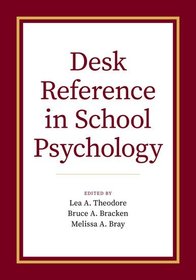
Desk Reference in School Psychology
-
20% KEDVEZMÉNY?
- A kedvezmény csak az 'Értesítés a kedvenc témákról' hírlevelünk címzettjeinek rendeléseire érvényes.
- Kiadói listaár GBP 100.00
-
45 150 Ft (43 000 Ft + 5% áfa)
Az ár azért becsült, mert a rendelés pillanatában nem lehet pontosan tudni, hogy a beérkezéskor milyen lesz a forint árfolyama az adott termék eredeti devizájához képest. Ha a forint romlana, kissé többet, ha javulna, kissé kevesebbet kell majd fizetnie.
- Kedvezmény(ek) 20% (cc. 9 030 Ft off)
- Kedvezményes ár 36 120 Ft (34 400 Ft + 5% áfa)
- A kedvezmény érvényes eddig: 2026. június 30.
Iratkozzon fel most és részesüljön kedvezőbb árainkból!
Feliratkozom
45 150 Ft

Beszerezhetőség
Becsült beszerzési idő: A Prosperónál jelenleg nincsen raktáron, de a kiadónál igen. Beszerzés kb. 3-5 hét..
A Prosperónál jelenleg nincsen raktáron.
Why don't you give exact delivery time?
A beszerzés időigényét az eddigi tapasztalatokra alapozva adjuk meg. Azért becsült, mert a terméket külföldről hozzuk be, így a kiadó kiszolgálásának pillanatnyi gyorsaságától is függ. A megadottnál gyorsabb és lassabb szállítás is elképzelhető, de mindent megteszünk, hogy Ön a lehető leghamarabb jusson hozzá a termékhez.
A termék adatai:
- Kiadó OUP USA
- Megjelenés dátuma 2024. február 26.
- ISBN 9780190092344
- Kötéstípus Keménykötés
- Terjedelem880 oldal
- Méret 185x251x66 mm
- Súly 1701 g
- Nyelv angol
- Illusztrációk 15 b/w line drawings 482
Kategóriák
Rövid leírás:
The Desk Reference in School Psychology provides practitioners, academics, and students with a compendium of current, evidence-based, and state-of-the-art best practices in education and psychology. This comprehensive, detailed, and empirically supported resource renders the Desk Reference an ideal, practical go-to guide for all school-based professionals, including classroom teachers, counselors, social workers, and school psychologists.
TöbbHosszú leírás:
Best practices related to assessment, consultation, and intervention have been well-documented throughout the school psychology literature, with ample empirical support. Unfortunately, despite this vast knowledge base, many practitioners continue to use outdated and ineffective assessment practices, educational interventions, and therapies, many of which lack research support. The Desk Reference's editors aim to change that by providing practitioners, academics, and students with a compendium of current, evidence-based, and state-of-the-art best practices in education and psychology.
The Desk Reference's comprehensive coverage of diverse populations and important niche matters confronting school personnel are systematically addressed in a uniform step-by-step manner replete with evidence-based practices that can be implemented immediately by practicing professionals. Doing ---what works--- is the basis of evidence-based best practices, and when services work, they lead to consistent, efficacious, and documented benefits.
Composed of contributed chapters from leading school psychology authors, the Desk Reference emphasizes sound application and comprehensive coverage within five topical sections: Assessment and Intervention (Cognitive, Academic, Social Emotional, Neuropsychology); Consultation; Medical Problems; Diversity in Learning; and Crises, Conditions, and Responses. This comprehensive, detailed, and empirically supported resource renders the Desk Reference an ideal, practical go-to guide for all school-based professionals, including classroom teachers, counselors, social workers, and school psychologists.
Tartalomjegyzék:
Preface
Lea A. Theodore, Bruce A. Bracken, Melissa A. Bray
Part One: Assessment and Intervention
Cognitive
Chapter 1: Cognitive-Intellectual Assessment of School-Age Children
John D. Wasserman
Chapter 2. Assessment of Gifted and Talented Children and Adolescents
Nicholas Gelbar, Sally M. Reis, and Joseph S. Renzulli
Chapter 3. Nonverbal Assessment
Natalie R. Hassett, R. Steve McCallum, and Bruce A. Bracken
Chapter 4. Preschool Assessment
Vincent C. Alfonso, Joseph R. Engler, and Esther Stavrou
Chapter 5. Intellectual Disabilities
Stephen Greenspan, John Driscoll, and Gail Loughlin Rogers
Academic
Chapter 6. Academic Assessment and Intervention
Rachel Brown-Chidsey
Chapter 7. Supporting Student Achievement in Elementary Mathematics: The Role of the School Psychologist
Ben Clarke, Marah Sutherland, Taylor Lesner
Chapter 8. Mathematics Disabilities, Low Achievement, and Relevant Evidence-Based Interventions
Elizabeth McCallum, Kathleen B. Aspiranti, and Ara J. Schmitt
Chapter 9. Dyslexia
R. Steve McCallum and Sherry Mee Bell
Chapter 10. Homework and Study Strategies
Lea A. Theodore and Dana E. Boccio
Chapter 11. Homeschooling in Children and Adolescents
Mary Louise Cashel and Lea A. Theodore
Social Emotional
Chapter 12. Personality, Social-Emotional, and Behavioral Assessment in Children and Adolescents
Sara Whitcomb and Hee Kyung Park
Chapter 13. Functional Behavioral Assessment and Behavior Intervention Plans
Tammy L. Hughes, Mary Comis, and Jeffrey A. Miller
Chapter 14. Disruptive Behavior Disorders in Children and Adolescents
Jeffrey D. Burke, Emilie J. Butler, and Asia G. Perkins
Chapter 15. Attention-Deficit/Hyperactivity Disorder
George J. DuPaul, Chelsea Z. Busch, and Alicia Chunta
Chapter 16. Depressive Disorders in Children and Adolescents
Ralph E. Cash, Alyssa Newman, Shannon Worton, and Natalia Mar--a Ram--rez, and Sarah Valley-Gray
Chapter 17. Pediatric Bipolar Disorder in Children and Adolescents
Mary A. Fristad
Chapter 18. Anxiety Disorders (Social, Separation, General) in Children and Adolescents
John S. Carlson and Sally Askar
Chapter 19. Obsessive-Compulsive Disorder in Children and Adolescents
Morgan M. McNeel, Stacey C. Grebe, Amanda Palo, Wayne K. Goodman, Eric A. Storch, and Sophie C. Schneider
Chapter 20. Specific Phobia in Children and Adolescents
Laura D. Seligman, Liza Talavera-Garza, and Thomas H. Ollendick
Chapter 21. School Attendance Problems
Christopher A. Kearney, Carolina Gonz--lvez, and Victoria Bacon
Chapter 22. Post-Traumatic Stress Disorder in Children and Adolescents
Stephen E. Brock
Chapter 23. Youth Suicidal Behavior
James J. Mazza and David N. Miller
Chapter 24. Nonsuicidal Self-Injury
David N. Miller and James J. Mazza
Neuropsychology
Chapter 25. Neuropsychological Assessment in Children and Adolescents: Applications for the School Psychologist
Stephen R. Hooper, Peter Duquette, Cari Pittleman, and Hanna Leong
Chapter 26. Autism Spectrum Disorder
Jonathan M. Campbell, Karena Cooper-Duffy, and Johanna Price
Chapter 27. Tourette Syndrome in Children and Adolescents
Aarti P. Bellara, Emily L. Winter, Johanna M. deLeyer-Tiarks, and Laura R. Freise
Chapter 28. Traumatic Brain Injury and Concussions in Children and Adolescents
Margaret Semrud-Clikeman
Part Two: Consultation
Chapter 29. Behavioral Consultation: Linking Referral Concerns, Intervention, and Outcomes
George H. Noell, Kristin A. Gansle, and Anna C. J. Long
Chapter 30. Conjoint Behavioral Consultation
Henry P. Bass, Karalynn E. Brown, and Susan M. Sheridan
Chapter 31. Instructional Consultation
Sylvia Rosenfield, Lauren Kaiser, and Kate Cramer
Chapter 32. Program Evaluation and Cultural Engagement: View with a 21st Century Lens
Enedina Garc--a-V--zquez and Luis A. V--zquez
Part Three: Medical Problems
Chapter 33. Asthma in Children and Adolescents
Melissa A. Bray, Emily Winter, Adeline Bray, Johanna M. deLeyer-Tiarks, and Sai Aravala
Chapter 34. Childhood Cancer in Children and Adolescents
Karen L. Cross, Lauren Gammie, and Cheryl Maykel
Chapter 35. Epidemiological Research in Schools: From Theory to Practice
Rich Gilman
Chapter 36. Adolescent Sexual Behavior: Prevalence, Risks, and Health-Affirming Supports
Adena B. Meyers and Laura Finan
Part Four: Diversity in Learning
Chapter 37. Social Emotional Learning in Children and Adolescents
Frank M. Gresham
Chapter 38. Evidence-Based Interventions for Children and Adolescents Who Experience Parental Separation and Divorce
Karey L. O'Hara, C. Aubrey Rhodes, and Sharlene A. Wolchik
Chapter 39. Positive Psychology in Education
Shannon M. Suldo, Letty DiLeo, and Katrina Scarimbolo
Chapter 40. Culturally Responsive Interventions: Issues, Status, Resources, and Steps-in-Adaptations
Margaret R. Rogers
Chapter 41. Sexual and Gender Minorities (SGM) in the Schools
Alan Smerbeck
Part Five: Crises, Conditions, and Responses
Chapter 42. Crisis Prevention, Preparation, and Intervention
Shane R. Jimerson, Mihya Weber, and Yuexin Zhang
Chapter 43. Supporting Students and Schools in the Aftermath of Natural Disasters
Philip J. Lazarus and Annela Costa
Chapter 44. Trauma-Informed Care in Children and Adolescents
Jacqueline A. Brown, Ashlyn Kincaid, and Jennifer Rotzal
Chapter 45. Threat Assessment
Dewey Cornell
Chapter 46. Resilience
Kathleen A. Yu and Frank C. Worrell

