

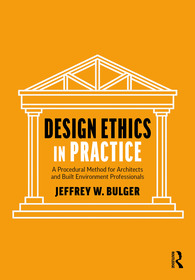
Design Ethics in Practice
A Procedural Method for Architects and Built Environment Professionals
-
20% KEDVEZMÉNY?
- A kedvezmény csak az 'Értesítés a kedvenc témákról' hírlevelünk címzettjeinek rendeléseire érvényes.
- Kiadói listaár GBP 155.00
-
69 982 Ft (66 650 Ft + 5% áfa)
Az ár azért becsült, mert a rendelés pillanatában nem lehet pontosan tudni, hogy a beérkezéskor milyen lesz a forint árfolyama az adott termék eredeti devizájához képest. Ha a forint romlana, kissé többet, ha javulna, kissé kevesebbet kell majd fizetnie.
- Kedvezmény(ek) 20% (cc. 13 996 Ft off)
- Kedvezményes ár 55 986 Ft (53 320 Ft + 5% áfa)
- A kedvezmény érvényes eddig: 2026. június 30.
Iratkozzon fel most és részesüljön kedvezőbb árainkból!
Feliratkozom
62 984 Ft

Beszerezhetőség
Még nem jelent meg, de rendelhető. A megjelenéstől számított néhány héten belül megérkezik.
Why don't you give exact delivery time?
A beszerzés időigényét az eddigi tapasztalatokra alapozva adjuk meg. Azért becsült, mert a terméket külföldről hozzuk be, így a kiadó kiszolgálásának pillanatnyi gyorsaságától is függ. A megadottnál gyorsabb és lassabb szállítás is elképzelhető, de mindent megteszünk, hogy Ön a lehető leghamarabb jusson hozzá a termékhez.
A termék adatai:
- Kiadás sorszáma 1
- Kiadó Routledge
- Megjelenés dátuma 2026. augusztus 17.
- ISBN 9781041336044
- Kötéstípus Keménykötés
- Terjedelem212 oldal
- Méret 254x178 mm
- Nyelv angol
- Illusztrációk 4 Illustrations, black & white; 3 Halftones, black & white; 1 Line drawings, black & white; 33 Tables, black & white 700
Kategóriák
Rövid leírás:
Design today speaks fluently of care—empathy, inclusion, community—but rarely of justification. Design Ethics addresses this gap by offering a reproducible, institution-ready method of ethical reasoning that can be taught, audited, and applied across professional design practice.
TöbbHosszú leírás:
Design today speaks fluently of care—empathy, inclusion, community—but rarely of justification. Design Ethics addresses this gap by offering a reproducible, institution-ready method of ethical reasoning that can be taught, audited, and applied across professional design practice.
Drawing on the procedural transformation of biomedical ethics following the Belmont Report, Jeffrey W. Bulger develops a parallel framework for architecture, planning, and the built environment. Where professional codes—UIA, NCARB, AIA, ARB, RIBA, RAIC, and NSCA—define obligations but avoid adjudicating ethical trade-offs, Design Ethics supplies the missing structure for deliberation and justification. Bulger translates principlism’s triad—respect for persons, beneficence, and justice—into design’s operative grammar: duty, consequence, and fairness. These principles are operationalized through practical instruments—the Duty Statement, Consequences Ledger, Fairness Report, and Design Ethics Board—that convert moral intention into publicly defensible decision-making.
Aligning ethics with the logic of the scientific method—hypothesis, evidence, review—Design Ethics reframes ethics as professional infrastructure, accountable to institutions and affected communities. Integrated appendices extend the method into procedures, governance, and pedagogy, ensuring ethical reasoning remains durable beyond individual judgment. Ethics becomes method.
Több
Tartalomjegyzék:
Prologue: Why Design Needs Ethics. 1. The Architecture of Ethics: From Aristotle to the Belmont Report. 2. Respect for Persons: Duty, Autonomy, and Truth in Design. 3. Beneficence and Nonmaleficence: Consequence and the Ethics of Impact. 4. Justice as Fairness: The Distribution of Benefits and Burdens. 5. Institutionalization: The Design Ethics Board (DEB). 6. Pedagogy, Reproduction, and Ethical Method. 7. The Moral Life of Materials. Epilogue: The Courage to Decide. Appendix Overview: Ethics as Procedural Infrastructure. Appendix A: Core Procedures (Templates). Appendix B: Governance Documents for the Design Ethics Board (DEB). Appendix C: Pedagogy Tools.
Több
