

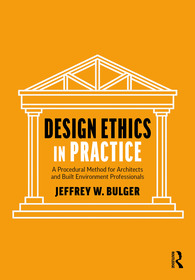
Design Ethics in Practice
A Procedural Method for Architects and Built Environment Professionals
- Publisher's listprice GBP 155.00
-
69 982 Ft (66 650 Ft + 5% VAT)
The price is estimated because at the time of ordering we do not know what conversion rates will apply to HUF / product currency when the book arrives. In case HUF is weaker, the price increases slightly, in case HUF is stronger, the price goes lower slightly.
- Discount 20% (cc. 13 996 Ft off)
- Discounted price 55 986 Ft (53 320 Ft + 5% VAT)
- Discount is valid until: 30 June 2026
Subcribe now and take benefit of a favourable price.
Subscribe
62 984 Ft

Availability
Not yet published.
Why don't you give exact delivery time?
Delivery time is estimated on our previous experiences. We give estimations only, because we order from outside Hungary, and the delivery time mainly depends on how quickly the publisher supplies the book. Faster or slower deliveries both happen, but we do our best to supply as quickly as possible.
Product details:
- Edition number 1
- Publisher Routledge
- Date of Publication 17 August 2026
- ISBN 9781041336044
- Binding Hardback
- No. of pages212 pages
- Size 254x178 mm
- Language English
- Illustrations 4 Illustrations, black & white; 3 Halftones, black & white; 1 Line drawings, black & white; 33 Tables, black & white 700
Categories
Short description:
Design today speaks fluently of care—empathy, inclusion, community—but rarely of justification. Design Ethics addresses this gap by offering a reproducible, institution-ready method of ethical reasoning that can be taught, audited, and applied across professional design practice.
MoreLong description:
Design today speaks fluently of care—empathy, inclusion, community—but rarely of justification. Design Ethics addresses this gap by offering a reproducible, institution-ready method of ethical reasoning that can be taught, audited, and applied across professional design practice.
Drawing on the procedural transformation of biomedical ethics following the Belmont Report, Jeffrey W. Bulger develops a parallel framework for architecture, planning, and the built environment. Where professional codes—UIA, NCARB, AIA, ARB, RIBA, RAIC, and NSCA—define obligations but avoid adjudicating ethical trade-offs, Design Ethics supplies the missing structure for deliberation and justification. Bulger translates principlism’s triad—respect for persons, beneficence, and justice—into design’s operative grammar: duty, consequence, and fairness. These principles are operationalized through practical instruments—the Duty Statement, Consequences Ledger, Fairness Report, and Design Ethics Board—that convert moral intention into publicly defensible decision-making.
Aligning ethics with the logic of the scientific method—hypothesis, evidence, review—Design Ethics reframes ethics as professional infrastructure, accountable to institutions and affected communities. Integrated appendices extend the method into procedures, governance, and pedagogy, ensuring ethical reasoning remains durable beyond individual judgment. Ethics becomes method.
More
Table of Contents:
Prologue: Why Design Needs Ethics. 1. The Architecture of Ethics: From Aristotle to the Belmont Report. 2. Respect for Persons: Duty, Autonomy, and Truth in Design. 3. Beneficence and Nonmaleficence: Consequence and the Ethics of Impact. 4. Justice as Fairness: The Distribution of Benefits and Burdens. 5. Institutionalization: The Design Ethics Board (DEB). 6. Pedagogy, Reproduction, and Ethical Method. 7. The Moral Life of Materials. Epilogue: The Courage to Decide. Appendix Overview: Ethics as Procedural Infrastructure. Appendix A: Core Procedures (Templates). Appendix B: Governance Documents for the Design Ethics Board (DEB). Appendix C: Pedagogy Tools.
More
