

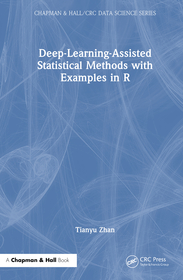
Deep-Learning-Assisted Statistical Methods with Examples in R
Sorozatcím: Chapman & Hall/CRC Data Science Series;
-
20% KEDVEZMÉNY?
- A kedvezmény csak az 'Értesítés a kedvenc témákról' hírlevelünk címzettjeinek rendeléseire érvényes.
- Kiadói listaár GBP 155.00
-
69 982 Ft (66 650 Ft + 5% áfa)
Az ár azért becsült, mert a rendelés pillanatában nem lehet pontosan tudni, hogy a beérkezéskor milyen lesz a forint árfolyama az adott termék eredeti devizájához képest. Ha a forint romlana, kissé többet, ha javulna, kissé kevesebbet kell majd fizetnie.
- Kedvezmény(ek) 20% (cc. 13 996 Ft off)
- Kedvezményes ár 55 986 Ft (53 320 Ft + 5% áfa)
- A kedvezmény érvényes eddig: 2026. június 30.
Iratkozzon fel most és részesüljön kedvezőbb árainkból!
Feliratkozom
62 984 Ft

Beszerezhetőség
Becsült beszerzési idő: A Prosperónál jelenleg nincsen raktáron, de a kiadónál igen. Beszerzés kb. 3-5 hét..
A Prosperónál jelenleg nincsen raktáron.
Why don't you give exact delivery time?
A beszerzés időigényét az eddigi tapasztalatokra alapozva adjuk meg. Azért becsült, mert a terméket külföldről hozzuk be, így a kiadó kiszolgálásának pillanatnyi gyorsaságától is függ. A megadottnál gyorsabb és lassabb szállítás is elképzelhető, de mindent megteszünk, hogy Ön a lehető leghamarabb jusson hozzá a termékhez.
A termék adatai:
- Kiadás sorszáma 1
- Kiadó Chapman and Hall
- Megjelenés dátuma 2026. március 16.
- ISBN 9781041158455
- Kötéstípus Keménykötés
- Terjedelem184 oldal
- Méret 234x156 mm
- Súly 500 g
- Nyelv angol
- Illusztrációk 5 Illustrations, black & white; 5 Line drawings, black & white; 31 Tables, black & white 687
Kategóriák
Rövid leírás:
This book explores how deep learning enhances statistical methods for hypothesis testing, point estimation, optimization, interpretation, and other aspects. This book is a valuable resource for students, practitioners, and researchers integrating statistics and data science techniques to solve impactful real-world problems.
TöbbHosszú leírás:
This book explores how deep learning enhances statistical methods for hypothesis testing, point estimation, optimization, interpretation, and other aspects. It uniquely demonstrates leveraging deep learning to improve traditional statistical approaches, showcasing their superior performance in practical applications. Each topic includes essential background, clear method explanations, and detailed R code demonstrations through case studies. This allows readers to directly apply these methods to their own challenges and easily adapt the underlying principles to related problems.
This book delves into statistical inference, introducing advanced strategies for hypothesis testing and point estimation. These innovative methods ingeniously combine both artificial and human intelligence, offering robust solutions for scenarios where traditional optimal analytical solutions are elusive or non-existent. A prime example of their real-world impact is in adaptive clinical trials, where these computational approaches can be readily implemented to optimize trial design and outcomes. The author further explores the multifaceted benefits of deep-learning-assisted statistical methods, extending beyond mere statistical efficiency. It highlights crucial features such as integrity protection, ensuring the trustworthiness of results; computational efficiency, enabling faster and more scalable analyses; and interpretability, which is increasingly vital for transparent communication of complex findings in modern statistics. This section encourages readers to consider a broader spectrum of improvements for new statistical methods, focusing on attributes that enhance their practical utility and societal relevance. Finally, the reader is given a critical examination of the limitations and potential concerns associated with the methods presented in earlier chapters. Crucially, it doesn't just identify these issues but also offers constructive mitigation approaches. This equips readers with essential techniques to safeguard AI-based methodologies with their scientific expertise, ensuring responsible and valid application of these powerful computational tools in diverse scientific and practical domains.
This book is a valuable resource for students, practitioners, and researchers integrating statistics and data science techniques to solve impactful real-world problems.
TöbbTartalomjegyzék:
I Introduction and Preparations
1. Introduction to Deep Neural Networks (DNNs)
2. How to Implement DNN in Regression
II Statistical Inference
3. Two-sample Parametric Hypothesis Testing
4. Point Estimation
III Numerical Methods
5. Optimization with Unavailable Gradient Information
6. Protect Integrity and Save Computational Time
7. Interpretable Models in Regression Analysis
IV Extensions
8. Substitutions of Other Methods for DNN
9. Limitations and Mitigations
10. Some Future Works
Több
