

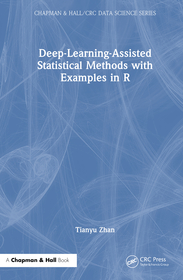
Deep-Learning-Assisted Statistical Methods with Examples in R
Series: Chapman & Hall/CRC Data Science Series;
- Publisher's listprice GBP 155.00
-
69 982 Ft (66 650 Ft + 5% VAT)
The price is estimated because at the time of ordering we do not know what conversion rates will apply to HUF / product currency when the book arrives. In case HUF is weaker, the price increases slightly, in case HUF is stronger, the price goes lower slightly.
- Discount 20% (cc. 13 996 Ft off)
- Discounted price 55 986 Ft (53 320 Ft + 5% VAT)
- Discount is valid until: 30 June 2026
Subcribe now and take benefit of a favourable price.
Subscribe
62 984 Ft

Availability
Estimated delivery time: In stock at the publisher, but not at Prospero's office. Delivery time approx. 3-5 weeks.
Not in stock at Prospero.
Why don't you give exact delivery time?
Delivery time is estimated on our previous experiences. We give estimations only, because we order from outside Hungary, and the delivery time mainly depends on how quickly the publisher supplies the book. Faster or slower deliveries both happen, but we do our best to supply as quickly as possible.
Product details:
- Edition number 1
- Publisher Chapman and Hall
- Date of Publication 16 March 2026
- ISBN 9781041158455
- Binding Hardback
- No. of pages184 pages
- Size 234x156 mm
- Weight 500 g
- Language English
- Illustrations 5 Illustrations, black & white; 5 Line drawings, black & white; 31 Tables, black & white 687
Categories
Short description:
This book explores how deep learning enhances statistical methods for hypothesis testing, point estimation, optimization, interpretation, and other aspects. This book is a valuable resource for students, practitioners, and researchers integrating statistics and data science techniques to solve impactful real-world problems.
MoreLong description:
This book explores how deep learning enhances statistical methods for hypothesis testing, point estimation, optimization, interpretation, and other aspects. It uniquely demonstrates leveraging deep learning to improve traditional statistical approaches, showcasing their superior performance in practical applications. Each topic includes essential background, clear method explanations, and detailed R code demonstrations through case studies. This allows readers to directly apply these methods to their own challenges and easily adapt the underlying principles to related problems.
This book delves into statistical inference, introducing advanced strategies for hypothesis testing and point estimation. These innovative methods ingeniously combine both artificial and human intelligence, offering robust solutions for scenarios where traditional optimal analytical solutions are elusive or non-existent. A prime example of their real-world impact is in adaptive clinical trials, where these computational approaches can be readily implemented to optimize trial design and outcomes. The author further explores the multifaceted benefits of deep-learning-assisted statistical methods, extending beyond mere statistical efficiency. It highlights crucial features such as integrity protection, ensuring the trustworthiness of results; computational efficiency, enabling faster and more scalable analyses; and interpretability, which is increasingly vital for transparent communication of complex findings in modern statistics. This section encourages readers to consider a broader spectrum of improvements for new statistical methods, focusing on attributes that enhance their practical utility and societal relevance. Finally, the reader is given a critical examination of the limitations and potential concerns associated with the methods presented in earlier chapters. Crucially, it doesn't just identify these issues but also offers constructive mitigation approaches. This equips readers with essential techniques to safeguard AI-based methodologies with their scientific expertise, ensuring responsible and valid application of these powerful computational tools in diverse scientific and practical domains.
This book is a valuable resource for students, practitioners, and researchers integrating statistics and data science techniques to solve impactful real-world problems.
MoreTable of Contents:
I Introduction and Preparations
1. Introduction to Deep Neural Networks (DNNs)
2. How to Implement DNN in Regression
II Statistical Inference
3. Two-sample Parametric Hypothesis Testing
4. Point Estimation
III Numerical Methods
5. Optimization with Unavailable Gradient Information
6. Protect Integrity and Save Computational Time
7. Interpretable Models in Regression Analysis
IV Extensions
8. Substitutions of Other Methods for DNN
9. Limitations and Mitigations
10. Some Future Works
More
