

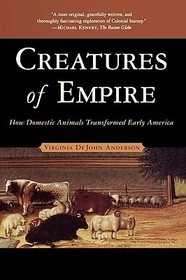
Creatures of Empire
How Domestic Animals Transformed Early America
-
10% KEDVEZMÉNY?
- A kedvezmény csak az 'Értesítés a kedvenc témákról' hírlevelünk címzettjeinek rendeléseire érvényes.
- Kiadói listaár GBP 19.99
-
9 025 Ft (8 595 Ft + 5% áfa)
Az ár azért becsült, mert a rendelés pillanatában nem lehet pontosan tudni, hogy a beérkezéskor milyen lesz a forint árfolyama az adott termék eredeti devizájához képest. Ha a forint romlana, kissé többet, ha javulna, kissé kevesebbet kell majd fizetnie.
- Kedvezmény(ek) 10% (kb. 903 Ft)
- Kedvezményes ár 8 122 Ft (7 736 Ft + 5% áfa)
Iratkozzon fel most és részesüljön kedvezőbb árainkból!
Feliratkozom
9 025 Ft

Beszerezhetőség
Megrendelésre a kiadó utánnyomja a könyvet. Rendelhető, de a szokásosnál kicsit lassabban érkezik meg.
Why don't you give exact delivery time?
A beszerzés időigényét az eddigi tapasztalatokra alapozva adjuk meg. Azért becsült, mert a terméket külföldről hozzuk be, így a kiadó kiszolgálásának pillanatnyi gyorsaságától is függ. A megadottnál gyorsabb és lassabb szállítás is elképzelhető, de mindent megteszünk, hogy Ön a lehető leghamarabb jusson hozzá a termékhez.
A termék adatai:
- Kiadó OUP USA
- Megjelenés dátuma 2006. május 25.
- ISBN 9780195304466
- Kötéstípus Puhakötés
- Terjedelem336 oldal
- Méret 234x157x18 mm
- Súly 485 g
- Nyelv angol
- Illusztrációk 7 halftones, 2 maps 0
Kategóriák
Rövid leírás:
Paperback edition of an original and groundbreaking work of colonial American history. Anderson argues that pigs, cows and other animals were critical agents of imperialism.
TöbbHosszú leírás:
When we think of the key figures of early American history, we think of explorers, or pilgrims, or Native Americans--not cattle, or goats, or swine. But as Virginia DeJohn Anderson reveals in this brilliantly original account of colonists in New England and the Chesapeake region, livestock played a vitally important role in the settling of the New World.
Livestock, Anderson writes, were a central factor in the cultural clash between colonists and Indians as well as a driving force in the expansion west. By bringing livestock across the Atlantic, colonists believed that they provided the means to realize America's potential. It was thought that if the Native Americans learned to keep livestock as well, they would be that much closer to assimilating the colonist's culture, especially their Christian faith. But colonists failed to anticipate the problems that would arise as Indians began encountering free-ranging livestock at almost every turn, often trespassing in their cornfields. Moreover, when growing populations and an expansive style of husbandry required far more space than they had expected, colonists could see no alternative but to appropriate Indian land. This created tensions that reached the boiling point with King Philip's War and Bacon's Rebellion. And it established a pattern that would repeat time and again over the next two centuries.
A stunning account that presents our history in a truly new light, Creatures of Empire restores a vital element of our past, illuminating one of the great forces of colonization and the expansion westward.
Anderson is highly successful in presenting the transformation of Early America from both the native and English sides ... she has produced a rare instance of a book that can make us look again at aspects of the historical landscape which have long been taken for granted.

